

A DUI can interrupt your daily routine, limit your ability to work, and create new insurance obligations. Getting your driving privileges back requires careful attention to both California Department of Motor Vehicles requirements and any orders issued by the court.
The process may involve a license suspension, DUI program enrollment, an SR-22 filing, reinstatement fees, and an ignition interlock device. Completing one step doesn't automatically clear the others. You must satisfy every condition that applies to your record before you may legally return to the road.
Understanding DUI insurance and license reinstatement rules can help you avoid missed deadlines, coverage lapses, and added delays. IIS Insurance Services helps California drivers secure affordable SR-22 and Non-Owner SR-22 policies while making the insurance portion of reinstatement easier to manage.
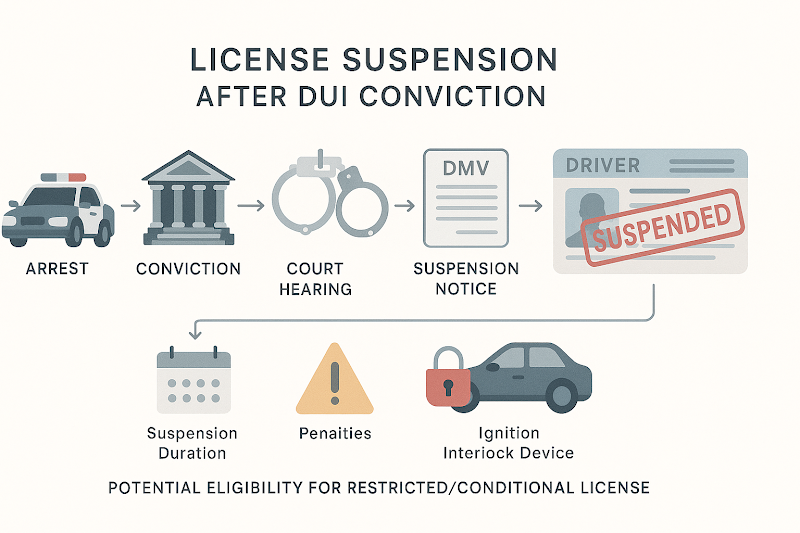
How a DUI Conviction Can Lead to License Suspension
A DUI case may involve both the California DMV and the criminal court. These are separate processes. The DMV can take administrative action against your license while the court decides the criminal case and related penalties.
This separation often causes confusion. Completing court requirements doesn't necessarily restore your license, and resolving a DMV suspension doesn't end the criminal case. Drivers should read every notice carefully and confirm which agency issued each requirement.
A DUI conviction may result in:
- A suspended or revoked driver's license
- Enrollment in an approved DUI education program
- Court fines and DMV fees
- An SR-22 financial responsibility filing
- Installation of an ignition interlock device
- Probation, community service, or treatment requirements
- Limits on when, where, or why you may drive
The length of a license suspension depends on factors such as prior offenses, chemical test results, test refusal, BAC level, and whether the incident caused injury. Repeat offenses may carry longer suspension periods and stricter reinstatement conditions.
A suspension temporarily removes your legal authority to drive. Revocation is different because the license is canceled. Following a revocation, you may need to meet additional conditions and reapply before the DMV grants new driving privileges.
Driving with a suspended license can lead to further penalties and may delay reinstatement. It can also make auto insurance harder to obtain. Don't drive until the DMV confirms that your license is valid or issues an approved restricted license.
Your suspension period may expire before every reinstatement requirement has been completed. Waiting out the stated period doesn't automatically make the license active again. You may still need to submit proof, pay a reinstatement fee, and complete other assigned tasks.
Keep your DMV notice, court documents, and program paperwork together. These documents provide the most reliable outline of the steps that apply to your case.
SR-22 Insurance and License Reinstatement
An SR-22 isn't a separate insurance policy. It's a certificate filed by an authorized insurer to confirm that you carry qualifying liability coverage.
California may require this proof after a DUI conviction or another serious driving violation. The insurer submits the SR-22 directly to the DMV, usually electronically. The filing remains connected to an active insurance policy.
You may need a standard car insurance policy with an SR-22 if you own a vehicle. If you don't own a vehicle, a Non-Owner SR-22 policy may be appropriate. The correct option depends on your ownership status, household vehicles, and how often you drive.
A non-owner policy generally provides liability protection when you occasionally operate certain borrowed or rented vehicles. It usually doesn't pay for physical damage to the vehicle you're driving. It may also be unsuitable if you regularly use a household member's car or should be listed on that person's policy.
Be accurate when describing your vehicle access. An incorrectly structured policy may not meet your insurance requirements or provide the expected protection after an accident.
| Reinstatement item | Purpose | Who handles it | What to watch for |
|---|---|---|---|
| Qualifying insurance policy | Provides required liability coverage | Driver and insurer | Coverage must match vehicle ownership and use |
| SR-22 filing | Proves financial responsibility to the DMV | Insurance company | The filing must remain connected to active coverage |
| DUI program documentation | Shows enrollment or completion | Driver and program provider | Requirements vary according to the case |
| Reinstatement fee | Clears applicable DMV charges | Driver and DMV | Paying the fee alone may not restore the license |
| Interlock documentation | Confirms installation when required | Driver and approved installer | The device must remain installed for the assigned period |
| License status confirmation | Verifies legal authority to drive | DMV | Don't drive until status is officially updated |
The SR-22 may need to remain active for a specified period. If the policy lapses, the insurer may notify the DMV. That notification can result in another suspension or interrupt the required filing period.
To maintain proof of insurance, make payments on time and update expired banking information promptly. Contact your insurance agency before changing companies, replacing a vehicle, moving, or canceling coverage.
Don't remove the filing simply because you have received a restricted license or completed a DUI program. Confirm with the DMV that the SR-22 requirement has ended before making changes.
IIS Insurance Services can help you compare policies, select the correct SR-22 option, and arrange the required filing. Working with an agency experienced in California high-risk insurance can reduce paperwork problems and prevent avoidable gaps.
Reinstatement Requirements and Documents to Prepare
License reinstatement involves several tasks that may need to be completed in a specific order. The exact requirements depend on your DMV record, court case, prior offenses, and any unresolved suspensions.
Start by confirming your current license status. Determine whether the license is suspended, revoked, restricted, or eligible for restoration. You should also check whether another violation or unpaid obligation is preventing reinstatement.
Common reinstatement steps include:
- Review the DMV and court notices. Identify the suspension period, deadlines, program requirements, and conditions for restricted or full driving privileges.
- Enroll in the assigned DUI program. Depending on your case, proof of enrollment may be enough for an initial restriction, while full restoration may require completion.
- Arrange an ignition interlock device when ordered. Use an approved provider and keep all installation records.
- Purchase an eligible insurance policy. The policy should reflect whether you own a vehicle and must support an SR-22 filing.
- Confirm that the SR-22 was submitted. Ask the insurer when the filing became effective and verify that the information is accurate.
- Pay applicable charges. This may include a reinstatement fee, program costs, court assessments, and interlock expenses.
- Submit supporting documents. Provide proof of enrollment, program completion, installation, payment, or other required actions.
- Wait for official confirmation. Don't assume that payment or document submission immediately changes your license status.
Paying outstanding fines is only one part of the process. A common question is, "If I pay my reinstatement fee, will my license still be suspended?" It may remain suspended if another requirement is incomplete or the DMV hasn't processed the necessary proof.
Keep copies of all receipts, forms, certificates, and communications. Record when each item was submitted and whom you spoke with. Organized records can help resolve processing delays or missing-document issues.
Deadlines may apply to hearing requests, program enrollment, insurance filings, and applications for restricted privileges. Add each date to your calendar and act early whenever possible.
An insurance agency can assist with coverage and the SR-22, but it can't clear court penalties, change the length of a suspension, or provide legal representation. Questions about the criminal case should be directed to a qualified attorney or the appropriate court.
Restricted and Hardship License Options
A restricted license may allow limited driving during part of a suspension. Depending on your eligibility, it may permit travel to work, school, a DUI program, medical appointments, or other approved locations.
California restrictions vary according to the offense and the driver's record. Some drivers may qualify for an ignition interlock restriction that permits broader vehicle use while the device is installed. Others may receive narrower work-and-program privileges.
The term hardship license is often used broadly for limited driving privileges granted because a full suspension would cause serious difficulty. California drivers should rely on the exact license category and instructions provided by the DMV rather than assuming that a general hardship application is available in every situation.
Eligibility may depend on:
- Whether the offense is a first or repeat DUI
- Completion of a required suspension period
- Enrollment in an approved DUI program
- Installation of an ignition interlock device
- An active SR-22 filing
- Payment of applicable DMV charges
- Clearance of unrelated license holds
- Compliance with court orders
An interlock device is connected to the vehicle's ignition system. The driver must provide a breath sample before starting the vehicle and may be required to provide additional samples while driving. The device records results and may report violations.
Installing the device doesn't by itself create legal driving privileges. You must satisfy the remaining conditions and receive approval from the DMV.
Restricted driving is still subject to limits. Driving outside the approved terms can create new penalties. Read the restriction carefully and carry any required documents while operating a vehicle.
If you need insurance before applying for restricted privileges, IIS Insurance Services can help determine whether you need a standard auto policy or Non-Owner SR-22. The team can also arrange the filing so the insurance requirement doesn't hold up the rest of your application.
How to Avoid Delays and Control Insurance Costs
Reinstatement can become expensive once insurance premiums, program tuition, court costs, DMV fees, and interlock charges are combined. Careful planning can help you manage these expenses without creating another setback.
Start by comparing insurance quotes from several carriers. Companies don't evaluate a DUI in exactly the same way. A carrier that offered a competitive rate before the offense may no longer be the best choice.
Compare quotes using the same:
- Drivers and vehicles
- Liability limits
- Deductibles
- Optional coverage
- Policy term
- Payment schedule
- SR-22 filing status
Review the full cost rather than focusing only on the monthly payment. A low monthly figure may come with a larger down payment, installment fees, reduced limits, or exclusions.
A higher deductible may reduce the cost of collision or comprehensive insurance, but it also increases what you must pay after a covered loss. Choose a deductible you could realistically manage.
If your vehicle is financed or leased, you may be required to maintain physical damage coverage. Dropping collision or comprehensive without checking the agreement could violate the lender's requirements.
Continuous coverage also matters. A lapse can lead to another DMV action and may make future rates higher. Set up automatic payments when practical, review insurer notices promptly, and notify the agency before making policy changes.
Maintaining a clean record after the DUI may improve your options over time. Avoid new violations, follow restricted-license conditions, and review your rate at renewal. Depending on the insurer, discounts may remain available for automatic payments, bundling, vehicle safety equipment, or other approved factors.
IIS Insurance Services has helped California drivers with difficult records since 2009. As an independent agency, it can compare participating insurers and help you find a policy that meets the reinstatement rules without relying on a single carrier.
Get Help with DUI Insurance and Reinstatement
Restoring your license requires steady follow-through. You may need to complete a program, install an interlock device, pay fees, submit proof, maintain insurance, and wait for the DMV to confirm your status.
IIS Insurance Services can handle the insurance portion with clear explanations and fast, friendly support. Its agents help California drivers compare SR-22 and Non-Owner SR-22 options, choose suitable coverage, and submit the required financial responsibility filing.
Gather your DMV notice, driver's license information, vehicle details, and current policy documents before requesting a quote. Contact IIS Insurance Services for help finding affordable coverage and moving one step closer to legal driving privileges.