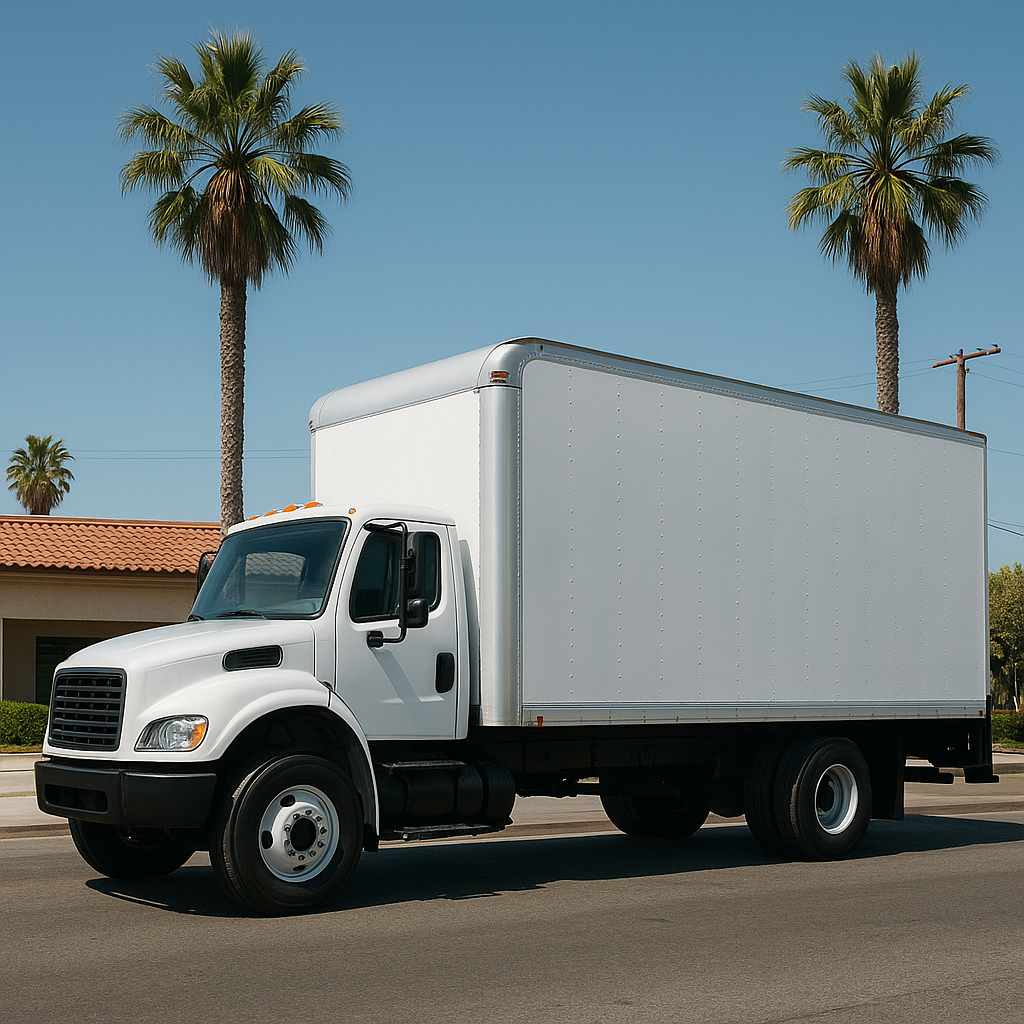
Box Truck Insurance in California

Get a free California auto insurance quote from IIS Insurance Services.
🔒 Secure  ·  🛡️ Licensed CA #0G56765  ·  ⭐ 4.9 (280+ reviews)
Name
Address
By clicking Submit, you agree that IIS Insurance and its agents may contact you at the phone number and email provided, including via autodialed calls, prerecorded messages, and SMS, about insurance products and quotes. Consent is not required as a condition of purchase. Message and data rates may apply. Reply STOP to opt out. See our Privacy Policy and Terms of Service.
Request your free insurance quote from IIS Insurance Services in California.

Reviewed by , Box Truck & Commercial Auto Insurance Specialist, 20+ Years Experience

CA Insurance License #0E94849 · IIS Insurance Services (CA Agency License #0G56765) · Verify license at CA DOI »

Last reviewed: April 30, 2026

Affordable Coverage Backed by Real Experience

If you’re driving a box truck for business, whether it’s deliveries, moving services, or hauling freight, you already know how important it is to keep your truck and your livelihood protected. 

That’s where we come in. At IIS Insurance Services, we’ve been helping California box truck owners and operators get the coverage they need since 2009. We know the ins and outs of box truck insurance, and we’re here to make the process simple, affordable, and stress-free.

Whether you’re a one-truck operation or managing a fleet, we’ll help you customize a policy that fits your business like a glove. 

Independent contractor? Local delivery service? No problem. We work with top-rated insurance carriers to offer competitive rates and fast coverage options, so you can focus on what you do best: running your business.

What Is Box Truck Insurance?

Box truck insurance is a type of commercial vehicle insurance designed specifically for (you guessed it): box trucks. These trucks, also called straight trucks, cube vans, or dry vans, are the backbone of many industries. They’re used for everything from moving services and retail deliveries to food distribution and furniture transport.

Because box trucks are commercial vehicles, they need more specialized insurance than your average car. A good policy protects your business from financial losses caused by accidents, 

property damage, cargo issues, or injuries involving your truck.

Think of it this way: your box truck isn’t just a vehicle, but instead, is a key part of your business. The right insurance guarantees that if something goes wrong, you’re not the one left footing the bill.

Who Uses Box Trucks?

Box trucks are the unsung heroes of countless industries. Here are just a few examples of businesses that rely on them (and for which purposes):

  • Moving Companies: Transporting furniture, appliances, and personal belongings.
  • Last-Mile Delivery Services: Getting packages to customers’ doorsteps.
  • Appliance and Furniture Delivery Businesses: Delivering large, heavy items to homes and businesses.
  • Food and Beverage Distributors: Keeping products fresh and ready for delivery.
  • Plumbing and Electrical Contractors: Hauling tools, equipment, and supplies to job sites.
  • Construction Companies: Transporting materials and equipment.
  • Florists and Event Rental Businesses: Delivering flowers, decorations, and rental items.
  • Courier and Freight Operators: Moving goods quickly and efficiently.
  • Retailers with Delivery Departments: Offering delivery services to customers.

The long and short of it is this: if your business depends on a box truck, you need insurance that keeps you compliant with the law and protected from unexpected costs.

What Does Box Truck Insurance Cover?

Box truck insurance isn’t one-size-fits-all. Your policy can be tailored to fit your business needs. Here’s what a typical policy includes:

Liability Insurance

This is the foundation of any commercial vehicle policy. It covers bodily injury and property damage you might cause in an accident. California has minimum liability requirements, but most businesses opt for higher limits to protect against lawsuits and large claims.

Physical Damage Coverage

This includes both collision coverage, which pays for repairs or replacement if your truck is damaged in a crash, no matter who’s at fault, as well as comprehensive coverage. Comprehensive coverage covers non-collision damage like theft, fire, vandalism, falling objects, or severe weather.

Cargo Insurance

If you’re hauling customer items, retail goods, tools, or supplies, cargo insurance protects you from losses if those items are stolen, damaged, or destroyed during transit.

Medical Payments or Personal Injury Protection (PIP)

This covers medical expenses for you and your passengers if you’re injured in an accident, regardless of fault.

Uninsured/Underinsured Motorist Coverage

This type of insurance protects you if someone without insurance (or with too little insurance) hits your truck.

Hired and Non-Owned Auto Coverage

If your business uses rental trucks or employees’ personal vehicles for work, this extends liability coverage to those situations.

Optional Add-Ons

Depending on your business, you might also need:

  • Trailer Interchange Coverage: For hauling trailers owned by others.
  • General Liability Insurance: Covers non-vehicle-related business risks.
  • Workers’ Compensation: Required in California if you have employees.
  • Business Interruption Coverage: Helps cover lost income if your truck is out of commission after a covered loss.

At IIS Insurance Services, we’ll help you sort through all these options and build a policy that fits your business (without paying for extras you don’t need).

Who Needs Box Truck Insurance?

If you’re using a box truck for business in California, you need commercial insurance. Here’s when it’s required:

  • Your truck is used for deliveries or transporting goods.
  • Your business name is displayed on the vehicle.
  • You operate under a commercial driver’s license or USDOT number.
  • You or your drivers use the truck to serve customers.
  • You lease your truck to another business or contract.
  • A shipper or vendor requires you to carry specific insurance.

Even if you’re a one-person operation or a gig worker renting a box truck, you need proper insurance to stay compliant and avoid liability headaches.

What Size and Types of Trucks Are Covered?

No matter the size of your business or the size of your truck, we’ve got your back. We cover a wide range of box trucks, including:

  • 10-foot box trucks
  • 14-foot and 16-foot delivery trucks
  • 20 to 26-foot moving trucks
  • Refrigerated box trucks
  • Flatbed or stake-side trucks with cargo enclosures
  • Light and medium-duty trucks for local deliveries
  • Trucks used for regional or long-haul operations

No matter if your truck is gas or diesel, leased or owned, used daily or occasionally, we’ll find a policy that fits your needs.

Gross Vehicle Weight Rating (GVWR) Tiers and California Box Truck Insurance Rules

How your box truck is insured (and what you’re legally required to carry) depends a lot on its GVWR. The rules step up at two key thresholds: 10,001 lbs and 26,001 lbs. Here’s how each tier works in California.

Under 10,001 lbs GVWR. This is your standard light-duty box truck, typical of 10-foot and many 14-foot delivery trucks. No CDL is required, no USDOT number is needed for in-state work, and you can run on a standard California commercial auto policy. State liability minimums apply (currently 50/100/25 under California law), though most operators carry $1,000,000 combined single limit to satisfy contracts and protect the business.

10,001 to 26,000 lbs GVWR. This is where most 16, 20, and 24-foot box trucks land. Still no CDL required for a single vehicle, but if you’re operating across state lines you need a USDOT number, and federal financial responsibility rules under 49 CFR §387.9 kick in. For general freight that’s $750,000 minimum liability. If you stay inside California, you register as a motor carrier with the CHP under California Vehicle Code §34501 and follow state motor carrier rules.

Over 26,001 lbs GVWR. Most 26-foot box trucks fall right around this line, and once you cross it, the requirements tighten significantly. A Class B CDL is required for the driver, a USDOT number is required for interstate work, and FMCSA financial responsibility minimums apply. Liability requirements typically run $750,000 to $1,000,000 depending on what you’re hauling, and many shippers and brokers contractually require $1,000,000.

If you’re not sure which tier your truck falls into, the GVWR is printed on the door jamb sticker. Send us the number and we’ll tell you exactly what coverage you need and what the policy will cost.

How Much Does Box Truck Insurance Cost?

Insurance costs depend on a few key factors:

  • Truck size and type: Bigger trucks usually cost more to insure.
  • Business use: What you haul and how far you travel affect your risk.
  • Driving history: Your record (and your employees’) matters.
  • Location: Where your truck is garaged and driven impacts your premium.
  • Coverage limits: More coverage means more protection, but also higher costs.
  • Claims history: Past claims can influence your rate.
  • Truck value: Newer or more expensive trucks cost more to insure.

To give you a rough idea, here are the annual ballparks we typically see for box truck insurance in California. These are general ranges for full coverage with $1,000,000 combined single limit liability and modest cargo limits, not actual quotes:

  • 10 to 14-foot light delivery box truck (under 10,001 lbs GVWR): roughly $3,000 to $4,500 per year
  • 16 to 20-foot box truck used for local delivery or moving: roughly $4,000 to $5,500 per year
  • 24 to 26-foot moving truck: roughly $4,500 to $6,500 per year
  • 26-foot refrigerated (reefer) box truck: roughly $6,000 to $8,500 per year (higher cargo value pushes the premium up)
  • Last-mile delivery fleet (Amazon DSP, FedEx ISP, regional courier): roughly $5,500 to $8,000 per vehicle per year, depending on contract minimums and fleet size

Where you actually land inside these ranges depends on the full picture: ZIP code, vehicle age, what you’re hauling, how many drivers are on the policy, and how recent any incidents are on the MVR. Fleets and businesses with a clean claims history and continuous coverage usually price toward the lower end.

At IIS Insurance Services we shop multiple carriers to find the best value for your operation. Send us your truck details and we’ll run real numbers for you.

How Box Truck Insurance Supports Daily Business Operations

For many businesses that use box trucks, insurance plays a direct role in keeping operations moving. A breakdown, accident, or theft can interrupt deliveries, delay contracts, and impact revenue. Having box truck insurance in place ensures that repairs, replacements, or claims do not fall entirely on your business.

This is especially important for a growing truck business where even a short downtime can affect customer relationships. Coverage is not just about compliance, it is about continuity and financial stability when unexpected events occur.

Physical Damage and Cargo Coverage Considerations

Beyond liability, physical damage coverage protects your box truck itself from repair or replacement costs after collisions, fire, theft, or vandalism. Box trucks often operate in tight loading zones, busy retail backlots, and high-traffic delivery areas, which raises the chance of damage. Comprehensive and collision are the two pieces most operators carry, and deductibles typically run from $500 to $2,500 depending on truck value and budget.

Cargo coverage is what protects the goods you’re hauling. Standard motor truck cargo policies usually run from $25,000 to $250,000 per load, with deductibles in the $1,000 to $2,500 range. The right limit depends on what you actually transport: a local florist needs a very different cargo policy than a furniture mover or a contractor hauling materials.

A few things to know about cargo coverage that catch operators off guard:

  • High-value electronics (laptops, phones, jewelry, fine art) are often capped or excluded under standard cargo and may require an inland marine policy for full protection.
  • Refrigerated freight is not automatically covered. If you’re running a reefer, you usually need a refrigeration breakdown endorsement (often called a temp-controlled or reefer breakdown rider) so a compressor failure that spoils the load isn’t on you.
  • Household goods for third parties (think moving company customer belongings) typically require an HHG endorsement and separate liability limits.
  • Some commodities like livestock, hazardous materials, and tobacco are excluded outright on most standard cargo policies.

We help match your cargo limits and endorsements to what you actually haul, so a dropped load or a freezer failure doesn’t turn into a business-ending claim.

General Liability and Business Insurance Connections

Many box truck operators also carry general liability and broader business insurance. These policies work alongside truck insurance to protect against non-driving risks, such as property damage or injuries that occur during loading and unloading.

For companies with employees, this layered approach helps reduce overall risk and ensures that different types of incidents are handled by the appropriate policy. Coordinating coverage prevents gaps that could otherwise leave your business exposed.

Commercial Auto Policies for Box Truck Drivers

Because box trucks fall under commercial auto, policies are structured differently than personal auto insurance. Box truck drivers often face higher exposure due to vehicle size, cargo weight, and frequent stops.

A well-built policy considers driver experience, usage patterns, and business operations. Working with an experienced agent helps ensure your coverage is aligned with how your trucks are actually used day to day.

Coverage for Last-Mile Delivery and Contracted Fleets

The last-mile delivery market has exploded across California, and a big share of those vehicles are box trucks and step vans run by independent contractors. Whether you operate as an Amazon Delivery Service Partner (DSP), a FedEx Ground Independent Service Provider (ISP), or run a regional courier route under your own name, the insurance requirements are tighter than a standard local-delivery policy.

Most national contracting programs require a $1,000,000 combined single limit on commercial auto, and they often want to see the contracting party listed as additional insured and as a certificate holder. That’s just the starting point. To run a clean operation that meets program minimums and protects the business, most fleets also need:

  • Hired and non-owned auto coverage, in case a driver uses a personal or rented vehicle for any work-related task
  • Motor truck cargo coverage sized to the route and the goods you carry
  • Commercial general liability for slips, falls, and property damage that happen off the truck
  • Workers’ compensation for every driver and helper on payroll, which is required by California law and almost always required by the contracting program
  • An umbrella or excess liability policy if your contract demands limits above $1,000,000

Premiums for last-mile fleets in California typically run $5,500 to $8,000 per vehicle per year for the auto piece alone, with cargo and general liability adding on top. Larger DSP and ISP operators with strong safety scores and clean MVRs across their drivers tend to land at the lower end. Newer operations or fleets with recent claims sit higher.

We work with last-mile operators across California to put the full stack in place: auto, cargo, hired/non-owned, general liability, workers’ comp, and umbrella. We make sure the certificates land in the right place so contracts don’t get held up. Tell us your route count, vehicle types, and program, and we’ll build the package.

Managing Claims, Repairs, and Downtime

When an accident happens, fast claim handling matters. Insurance helps pay for covered repairs, rental trucks, or other solutions that keep your business running. Efficient claims support minimizes downtime and helps you get back on the road quickly.

Choosing coverage that emphasizes responsive service can make a meaningful difference during stressful situations.

Real Stories from Businesses We’ve Helped

We’ve worked with businesses of all sizes across California. Here are a few examples of folks we’ve helped:

Miguel from San Pedro

He runs a small moving company with three 16-foot box trucks. He came to us after his previous insurer raised his rates. We helped him get a policy with higher limits and lower deductibles, while saving him over $1,000 per year.

Mariella from La Mirada 

Mariella owns a florist shop that offers same-day delivery. She uses a refrigerated box truck to deliver arrangements. We found her a policy that included cargo and refrigeration unit coverage at a very affordable rate.

Oscar from San Jose

Oscar from San Jose is an independent contractor who rents box trucks for local deliveries. He needed non-owned vehicle coverage that would protect him when using client trucks. We customized a policy that gave him liability protection and met the contract requirements of his delivery app.

Why Choose IIS Insurance Services?

Curious why California businesses repeatedly trust us for box truck insurance? 

First, we have been insuring commercial and box trucks since 2009. We’re proud of our partnerships with top-rated carriers specializing in business coverage, along with our competitive rates and flexible payment options. We have bundling options for auto, general liability, and workers’ comp, and we can provide fast, no-obligation quotes by phone or online.

No matter the size of your business, from startups to fleets, we’ll make the process as easy, transparent, and affordable as possible. That way, you can focus on running your business. Leave the rest to us.

Fast Coverage. Flexible Options. Friendly Experts.

Getting box truck insurance doesn’t have to be complicated. At IIS Insurance Services, we make it simple. Our licensed agents will walk you through your options, answer your questions, and explain exactly what you need to stay protected and compliant.

You can call us, get a quote online, or meet with one of our friendly advisors. We work with drivers and business owners throughout California, including in:

  • Los Angeles
  • San Diego
  • Sacramento
  • Fresno
  • San Jose
  • Riverside
  • Bakersfield
  • And more

Wherever your business is based, we’re here to help. We’ll walk you through the process quickly and seamlessly, because we want you to be able to get back on the road fast. After all, you have a business to run! We don’t want a single thing to stand in your way.

Get Insured Today

If you own or operate a box truck in California, now’s the time to protect your business with the right insurance. IIS Insurance Services has the experience, options, and pricing you need. 

Call IIS Insurance Services today or request a free quote online. Our agents are standing by to help you insure your box truck, protect your business, and drive with peace of mind.

Get a Free Quote Now!

Box Truck Insurance FAQs (California)

Quick answers to the questions California box truck owners and operators ask most.

What is box truck insurance?

Box truck insurance is a commercial policy built for straight trucks/cube vans used for business. It typically includes liability and can be customized with physical damage and cargo-related protections.

Is commercial insurance required for a box truck in California?

Yes, if the box truck is used for business purposes, it generally needs commercial coverage (not a personal auto policy).

What does box truck insurance usually cover?

Common options include commercial auto liability, collision, comprehensive (theft/fire/weather), medical payments, uninsured/underinsured motorist, and endorsements depending on your operation.

Do I need cargo insurance for a box truck?

Often, yes, especially if you haul customer goods. Liability covers damage you cause to others, but cargo coverage is designed to help with certain losses to the goods you’re transporting.

How much does box truck insurance cost in California?

Pricing depends on your truck value, radius/miles, what you haul, driver records, garaging location, limits, deductibles, and whether you’re a one-truck operation or a fleet.

Can new ventures and new DOT numbers get insured?

Yes, many carriers will write policies for new ventures, but documentation and pricing can vary. The goal is to match the operation to the right market.

Can I get box truck insurance the same day?

Often, yes, once the application is complete (driver/truck info, operations, and any required documents), many policies can be issued quickly with proof of insurance.

What info do I need to get a box truck insurance quote?

Usually: vehicle VIN/year/make/model, garaging ZIP, driver details, what you haul, your operating radius, prior insurance history, and any filings required for your work.

Reviews
★★★★★ 4.9
280+ reviews See our rating