

A DUI can affect your ability to drive, your insurance options, and the amount you pay for coverage. California drivers may face a license suspension, an SR-22 filing requirement, higher premiums, and fewer carrier choices after an alcohol-related offense.
The effects don't always begin with a conviction. A DUI arrest can trigger an administrative action through the California Department of Motor Vehicles while the criminal case moves through the court system. These are separate processes, and each may place different conditions on your driving privileges.
Understanding DUI insurance and driving record consequences can help you respond promptly, prevent coverage gaps, and avoid further setbacks. IIS Insurance Services helps California drivers compare standard auto, SR-22, and Non-Owner SR-22 policies after serious traffic violations. The focus is straightforward: meet your legal insurance requirements while finding coverage that fits your current needs and budget.
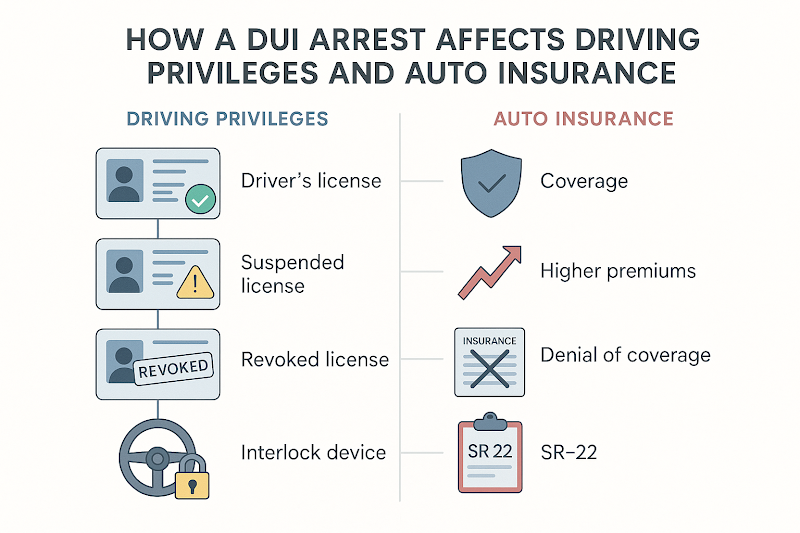
How a DUI Arrest Affects Your Driving Privileges
A DUI arrest may start two proceedings. The criminal court determines whether you're convicted and what criminal penalties apply. The DMV may take separate administrative action against your driver's license.
Because these proceedings are independent, a driver could face a DMV suspension before the court case is resolved. Responding to court requirements doesn't automatically resolve a DMV action, and meeting DMV conditions doesn't end the criminal case.
Possible consequences following an arrest include:
- Temporary confiscation of your driver's license
- Administrative license suspension
- Court-ordered license restrictions
- Required enrollment in a DUI program
- Installation of an ignition interlock device
- Fines, assessments, probation, or other criminal penalties
- Proof of financial responsibility through an SR-22 filing
The outcome depends on several factors, including your prior record, test results, whether you refused chemical testing, and whether the incident involved an accident or injury.
A first DUI charge may be treated differently from later DUI convictions. Repeat offenses commonly bring longer suspension periods, stricter reinstatement rules, and higher costs. An incident involving injuries can also create additional criminal and civil liability concerns.
License Suspension and License Revocation
A license suspension temporarily removes your authority to drive. You may be eligible to restore full or restricted driving privileges after completing the assigned period and satisfying specific requirements.
License revocation is usually more serious. It cancels the license rather than temporarily pausing it. A driver may need to satisfy all outstanding conditions and submit a new application before receiving driving privileges again.
Don't assume that purchasing insurance makes it legal to drive. An active insurance policy and SR-22 filing address financial responsibility. You must still receive confirmation from the DMV that your license is valid or that an approved restriction has been issued.
Driving while suspended can create new legal problems, extend the time needed to restore your license, and make future car insurance even harder to obtain.
How a DUI Conviction Affects Your Insurance
A DUI conviction affects your insurance because carriers use driving history to estimate the likelihood of future claims. A serious alcohol-related offense signals greater risk, so an insurer may adjust your premium, change your policy terms, or decline to continue coverage.
The conviction may appear when a company reviews your motor vehicle record during a new application or policy renewal. Once discovered, it may raise your auto insurance rate even if you didn't cause an accident.
Common insurance consequences include:
- A substantial increase in premiums
- Loss of a safe-driver or violation-free discount
- Nonrenewal by the current carrier
- Fewer available payment plans
- Reduced access to preferred insurance programs
- A requirement to purchase coverage through a high-risk carrier
- Additional fees associated with an SR-22 filing
Not every company responds in the same way. One insurer may raise the rate sharply, while another may specialize in drivers with recent violations and offer a more manageable price. This is why comparing several properly matched quotes matters.
A comparison should use the same drivers, vehicles, liability limits, deductibles, and optional coverage. A low quote may look attractive because it provides less protection or excludes coverage you expected to receive.
Why Insurance Rates Increase
Insurance rates are based partly on expected risk. A DUI can indicate a higher likelihood of an accident, injury claim, property damage claim, or future traffic offense. The insurer charges a higher premium to account for that increased exposure.
Your final rate may also depend on:
- Age and years of driving experience
- Residential location
- Type and value of the car
- Annual mileage
- Previous claims and violations
- Number of drivers on the policy
- Selected liability limits
- Collision and comprehensive deductibles
- Continuous insurance history
The DUI is only one rating factor, but it can have a large effect. Two drivers with similar convictions may receive very different quotes because their vehicles, locations, prior records, and coverage choices are different.
California generally uses the term DUI. Other states may use DWI, meaning driving while intoxicated or impaired. Regardless of the term, insurers usually treat an alcohol- or drug-related driving conviction as a serious offense.
SR-22 and Non-Owner Insurance after a DUI
An SR-22 is not a separate type of insurance. It's a certificate filed by an authorized insurer to show the DMV that you carry qualifying liability coverage.
The filing is commonly required when a driver seeks to restore driving privileges after a DUI, uninsured accident, or other serious violation. The SR-22 must be connected to an active policy that meets California's financial responsibility requirements.
A lapse can cause another problem. If the policy is canceled, expires, or becomes inactive, the insurer may notify the DMV. That notification can trigger a new suspension or interrupt the required filing period.
| Coverage or filing | Who may need it | What it provides | Important limitation |
|---|---|---|---|
| Standard auto policy with SR-22 | A driver who owns a vehicle | Liability coverage for the insured car and SR-22 proof for the DMV | Premiums may be higher after a DUI |
| Non-Owner SR-22 policy | A driver who doesn't own a vehicle | Liability coverage while driving certain borrowed or rented vehicles | Usually doesn't cover damage to the vehicle being driven |
| Standard policy without SR-22 | A driver with no filing requirement | Selected liability and physical damage coverage | Doesn't satisfy an active SR-22 requirement |
| Collision and comprehensive coverage | A vehicle owner seeking protection for the insured car | Coverage for certain collision, theft, weather, and other losses | Deductibles and exclusions apply |
When a Non-Owner SR-22 May Apply
A Non-Owner SR-22 policy may be suitable when you don't own a car but need proof of insurance to reinstate your license. It may cover your liability while occasionally driving a borrowed or rented vehicle.
It's not the right choice for every driver. A non-owner policy may not apply when:
- You own a registered vehicle
- You regularly drive the same car
- You live with someone whose vehicle you frequently use
- You should be listed as a driver on another household policy
- You need coverage for damage to the borrowed vehicle
Be direct with the insurance agent about vehicle ownership and access. An inaccurately written policy may fail to meet DMV requirements or leave you without the protection you expected after an accident.
IIS Insurance Services works with drivers who need standard SR-22 and Non-Owner SR-22 options. Its agents can help determine which policy type matches your situation and arrange the required filing with the DMV.
Steps to Restore Coverage and Return to the Road
Restoring driving privileges can require several coordinated actions. The exact order depends on the DMV notice, court orders, and details of the offense.
Start by reading every notice carefully. Missing a deadline or assuming one agency has updated another can delay reinstatement.
A typical process may involve:
- Confirm your license status. Determine whether your license is suspended, revoked, restricted, or eligible for reinstatement.
- Complete the required DUI program. You may need to enroll in or finish a state-approved education or treatment program.
- Address ignition interlock requirements. If an ignition interlock device is ordered, use an approved provider and retain the installation paperwork.
- Purchase qualifying insurance. Choose a policy that meets California liability requirements and reflects whether you own a vehicle.
- Have the insurer file the SR-22. Confirm when the filing becomes effective and whether it was submitted electronically.
- Pay required fees. DMV, court, program, and installation fees may apply.
- Receive confirmation before driving. Don't resume driving until the DMV confirms that your privileges are valid or restricted.
Keep copies of insurance documents, receipts, court orders, program certificates, and DMV correspondence. Having an organized record can help resolve questions quickly if a filing or payment isn't reflected correctly.
Preventing an SR-22 Coverage Lapse
Maintaining continuous coverage is one of the most important responsibilities during an SR-22 period. Even a brief interruption can be reported.
Reduce the chance of a lapse by setting up automatic payments, updating expired card information, and reviewing notices from the insurer promptly. Contact the agency before switching companies, changing vehicles, moving, or canceling a policy.
Don't cancel your SR-22 simply because your license has been reinstated. The filing may need to remain active for a specified period. Confirm that the requirement has ended before removing it.
Finding Affordable Car Insurance with a DUI on Your Record
A DUI usually increases the cost of coverage, but accepting the first available quote can lead to unnecessary expense. Insurers use different underwriting rules, so shopping across several carriers may reveal meaningful differences.
Begin by requesting quotes with identical coverage. Compare the full policy cost, not only the advertised monthly payment.
Review:
- Down payment
- Monthly installment amount
- Policy and filing fees
- Liability limits
- Deductibles
- Exclusions
- Optional coverage
- Renewal terms
- Cancellation rules
Ask whether the quote includes the SR-22 filing and when the filing will reach the DMV. A low price doesn't help if the company can't provide the required document or if the policy doesn't satisfy your legal obligation.
You may be able to lower the premium by adjusting optional coverage or selecting a higher deductible. However, a higher deductible means you will pay a larger amount after a covered claim. It should remain within your realistic budget.
Vehicle choice can also matter. Expensive, high-performance, frequently stolen, or costly-to-repair cars may carry higher premiums. Before replacing a vehicle, request an insurance estimate for the exact make, model, and year.
Maintaining a clean driving record after the offense may gradually improve your options. Avoid new violations, keep coverage active, and review quotes at renewal. Depending on the carrier, you may still qualify for savings related to automatic payments, bundling, vehicle safety equipment, or other approved factors.
IIS Insurance Services has helped California drivers with difficult records since 2009. As an independent agency, it can compare participating carriers rather than limiting you to one company's rates and underwriting rules.
Get Help with California DUI Insurance
A DUI can change your driving privileges, insurance eligibility, and household budget. Acting quickly and maintaining accurate coverage can help you avoid further suspension, filing problems, and unnecessary costs.
IIS Insurance Services helps California drivers compare auto insurance, SR-22 filings, and Non-Owner SR-22 policies after serious driving violations. You receive clear answers from a live agent, help choosing the right policy type, and support submitting the documents required for reinstatement.
Have your driver's license information, vehicle details, DMV notice, and current policy ready when requesting a quote. Contact IIS Insurance Services to compare available options and take the next step toward legal, continuous coverage.