

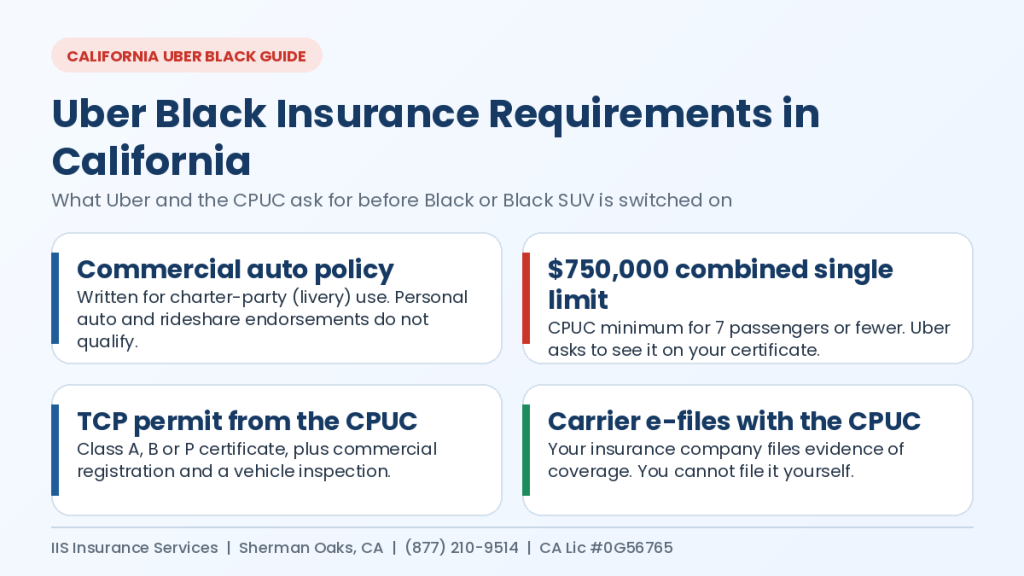
For Uber Black, Uber Black SUV, Lyft Black or a California limo service, a personal auto policy is not enough. You need commercial auto insurance, commercial vehicle registration and a TCP permit from the California Public Utilities Commission, because you operate as a charter-party carrier.
The exact coverage and filings depend on how you run your business. Here is the short answer, plus what California drivers need to check before going online. IIS Insurance Services in Sherman Oaks writes Uber Black insurance in California every week, and this is the checklist we walk new drivers through.
Uber Black insurance requirements California: the short answer
If you drive Uber Black in California, personal auto insurance will not cover you. California law requires that rideshare drivers have specific insurance, and for UberX drivers Uber carries it. Uber Black is different. Uber classifies Black and Black SUV drivers as commercial drivers, which means you bring your own commercial policy and your own permit, and Uber’s rideshare (TNC) policy does not apply to your trips. Uber says this directly in its commercial coverage FAQ.
The Uber Black insurance requirements California drivers should plan for are:
- A commercial auto liability policy written for charter-party (livery) use, with at least $750,000 combined single limit for a vehicle that seats 7 passengers or fewer (8 people including the driver). That is the CPUC minimum under General Order 115, and it is the figure Uber asks to see on your certificate.
- Uninsured and underinsured motorist coverage, which most livery carriers include or require.
- Physical damage coverage (collision and comprehensive) if the car is financed or leased, and in practice for any late-model luxury vehicle.
- Evidence of insurance e-filed with the CPUC by your insurance company. You cannot file it yourself.
Based on quotes we are seeing in 2026, a single owner-operator in Southern California should expect roughly $1,000 to $1,500 a month for a compliant policy. If someone quotes you $400 a month, it is not a California livery policy.
| Requirement | What it means for an Uber Black driver | How to verify |
|---|---|---|
| Commercial auto policy | Your own commercial policy on the vehicle before you accept a Black trip. Personal auto insurance does not qualify. | The declarations page shows commercial auto, livery or charter-party use. |
| Liability limit | $750,000 CSL for 7 passengers or fewer; $1.5 million for 8 to 15; $5 million for 16 or more. | The limit on your certificate matches the seating capacity on your registration. |
| UM/UIM | Pays for injury to you and your passengers when the other driver has little or no insurance. | Listed as a coverage line on the policy. |
| Physical damage | Collision and comprehensive on your own vehicle, required by any lender. | Lender listed as loss payee on the certificate. |
| CPUC filing | Your carrier e-files proof of coverage; the CPUC will not activate or keep a TCP without it. | Your TCP status shows “active” on the CPUC carrier lookup. |
| Matching records | Named insured, VIN and business name must match your TCP and your Uber vehicle profile. | Compare the certificate, the TCP letter and the Uber app vehicle page. |
Who needs commercial auto insurance for Uber Black
Every driver who accepts Black, Black SUV or Lyft Black trips in California, whether you own one car or run a small fleet. The same applies to prearranged limo, wine tour and corporate shuttle work. If money changes hands for the ride and the vehicle is dispatched, you are a charter-party carrier in the eyes of the CPUC.
Personal rideshare insurance, TNC insurance and the coverage gap
A rideshare endorsement on a personal policy helps UberX and Lyft drivers during the period when the app is on but no ride has been accepted. It is built around Uber’s TNC coverage picking up once a trip starts.
That structure does not exist for Uber Black. Uber’s TNC insurance covers TNC drivers. It does not cover commercial drivers, and a personal policy with a rideshare endorsement still excludes livery use. If you have an accident on a Black trip with only a personal policy, expect the claim to be denied and your TCP to be at risk.
- Confirm your personal policy excludes livery and charter-party use (almost all do).
- Do not rely on a rideshare endorsement for Black, Black SUV or Lyft Black.
- Get a commercial policy bound before your TCP application goes in.
- Send the certificate to Uber only after your carrier has e-filed with the CPUC.
California TCP requirements, vehicle registration and insurance filings
The CPUC charter-party permit is the license for the business. Uber checks for it, LAX checks for it, and your insurance company files against it. The application requires a $1,000 fee ($1,500 for a Class A certificate), enrollment in the DMV Employer Pull Notice program, a drug and alcohol testing program, workers compensation or a signed officer waiver if you have no employees, and your carrier’s e-filed evidence of insurance. The permit renews every three years.
Uber then asks for the TCP certificate in your name or your company’s name, a Secretary of State Statement of Information if you operate as an LLC or corporation, Uber’s California subcarrier acknowledgement, commercial vehicle registration and a vehicle inspection. Commercial registration matters: a vehicle registered for personal use will be rejected by Uber and can void the commercial policy.
Luxury vehicle coverage for Uber Black sedans and SUVs
Uber Black work calls for a qualifying vehicle: a recent model year luxury sedan or full-size SUV with a black exterior and black leather interior, driven by someone with a 4.85 rating or better. Uber updates the eligible model list every year, so check it before you buy.
From the insurance side, the vehicle’s value drives the premium. A new Escalade, Navigator or S-Class costs more to repair than a five-year-old sedan, so physical damage is the largest line on most Black policies. Tell us how the car is titled and registered, where it is garaged, and whether you drive for Uber Black, Lyft Black, private clients or all three. A vehicle that qualifies on the app can still need separate underwriting approval from the carrier.
Certificates and documents to prepare
Keep these available in the vehicle and on your phone: commercial auto ID cards, commercial registration, your TCP letter and the current certificate of insurance. When Uber, a hotel, an airport or a corporate client asks for proof of insurance, the certificate has to show the right named insured, VIN, liability limit and, for contracts, additional insured wording. A mismatch is the most common reason a certificate gets bounced.
- Disclose Uber Black, Lyft Black, limo and charter work to your carrier up front.
- Ask for certificates with the exact wording the requester gave you.
- After an accident, report it the same day and keep trip records, photos and contact details.
- When you replace a vehicle mid-term, get the policy, the CPUC filing and the certificates updated before the first trip.
Once you know what’s required, our post on how to get Uber Black insurance explains who actually sells it and what happens after you call.
California commercial auto rating, common mistakes and FAQs
Commercial auto pricing in California looks at the vehicle’s year and value, garaging zip, driver history, annual mileage, seating capacity, limits selected and claims record. A quote that looks unusually cheap usually leaves out physical damage, uses the wrong vehicle class, or is a personal policy in disguise.
The mistakes we see most: treating personal auto insurance as coverage for paid trips, listing the wrong garaging address, leaving a regular driver off the policy, and shopping on monthly payment alone without checking limits and deductibles. A detailed breakdown is in our guide to Uber Black insurance cost in California.
Ready to get quoted? Call IIS Insurance Services at (877) 210-9514 with your VIN, seating capacity and TCP status. We shop several insurance companies that write California livery, and the insurance company files with the CPUC.
Frequently asked questions
Do I need commercial auto insurance to drive Uber Black in California?
Yes. Uber Black drivers are commercial drivers under Uber’s rules and charter-party carriers under CPUC rules. Personal auto insurance and rideshare endorsements do not meet the requirement.
Does Uber’s insurance replace my commercial policy?
No. Uber’s TNC policy covers UberX-type trips only. On Uber Black your own commercial policy is the coverage on every trip.
What liability limit does Uber ask for in California?
A certificate showing at least $750,000 per vehicle, which matches the CPUC minimum for vehicles seating 7 passengers or fewer.
What documents do I need for Uber Black insurance in California?
Driver’s license and history for every driver, the VIN and seating capacity, commercial registration, your TCP number or application, garaging address, estimated mileage and any prior commercial policy.