

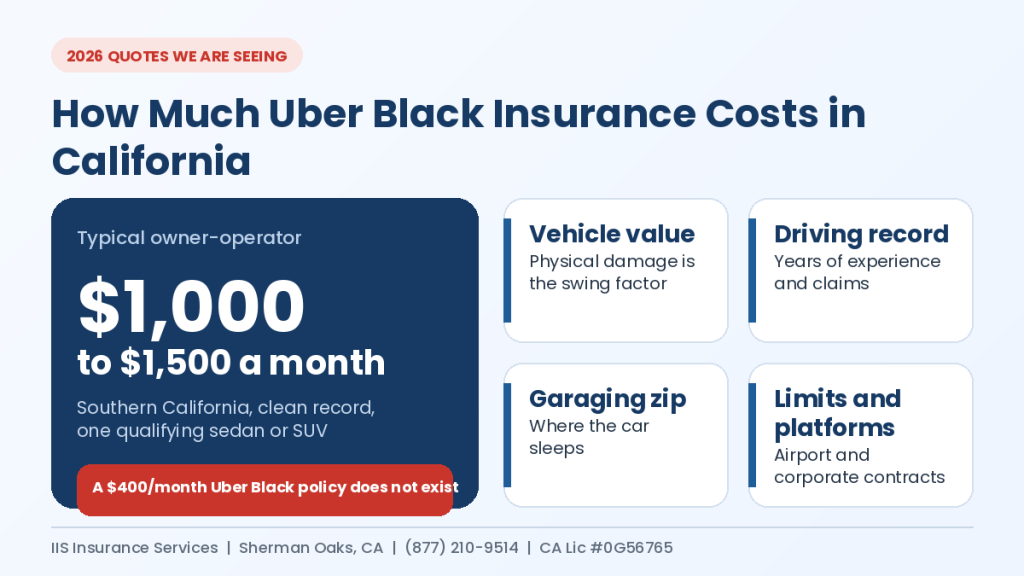
Uber Black insurance in California runs roughly $1,000 to $1,500 a month per vehicle in 2026 for a single owner-operator with a clean record. That is $12,000 to $18,000 a year, and Black SUV and limo policies with higher limits can go above it. Here is what California drivers actually pay, why the price moves, and how to keep it at the low end without leaving a gap.
The numbers in this post come from quotes IIS Insurance Services is placing for Uber Black, Lyft Black and limo drivers in Southern California this year, not from a national average.
Uber Black insurance cost California: a quick answer
Uber Black insurance costs more than standard rideshare coverage because the vehicle, the liability limit and the driver profile are all commercial. A personal policy with a rideshare endorsement might run a few hundred dollars a month. A CPUC-compliant commercial auto policy on a qualifying Black vehicle starts around $1,000 a month and tops out around $1,500 for most solo drivers we quote.
One warning. If a website tells you Uber Black insurance starts at $400 a month, that number does not exist for a compliant California policy on a qualifying vehicle. It is a personal policy, a different state, or a quote that leaves out physical damage.
Black commercial insurance pricing, limits and deductibles
A Black commercial policy carries higher liability limits than personal auto insurance. The CPUC minimum is $750,000 combined single limit for a vehicle seating 7 passengers or fewer (8 people including the driver), $1.5 million for 8 to 15 passengers and $5 million for 16 or more. Most Black sedans and SUVs sit at $750,000, which is also what Uber asks to see on your certificate. Airport contracts and corporate accounts sometimes ask for $1 million, and that bump adds to the premium.
Physical damage is the other big line. Collision and comprehensive on a late-model Escalade, Navigator or S-Class is often half the total premium. Your deductible moves it: a $2,500 deductible costs less per month than $1,000, but you pay more after a loss. We help you pick a number you could actually write a check for the week after an accident.
Why Uber Black commercial insurance costs more
Three things push the price up compared with UberX. First, the vehicle: luxury cars have expensive parts, sensors and paint, so every claim costs the carrier more. Second, the exposure: you are transporting passengers for hire under a CPUC permit, and the carrier has to file with the state and stand behind the limit. Third, the market: only a handful of carriers write California livery, so there is less competition than in personal auto.
Rideshare endorsements are cheap because Uber’s TNC policy does most of the work on UberX trips. On Uber Black there is no TNC policy behind you. Your commercial policy is the only coverage on every trip, and it is priced that way.
Uber Black, Black SUV, Lyft Black and California TCP service compared
The insurance requirement is the same across all of them: a commercial policy tied to a TCP permit. What changes the price is the vehicle. A Black sedan (E-Class, 5 Series, A6) is the cheapest to insure. A Black SUV (Escalade, Navigator, Suburban) costs more because the vehicle is worth more and seats more. A stretch limo or sprinter seating 8 to 15 needs $1.5 million in liability and a CHP inspection, and the premium reflects it. Lyft Black uses the same policy as Uber Black; you just add the platform to the application.
Commercial insurance coverage to discuss with your agent
- Auto liability at the CPUC minimum for your seating capacity, or higher if a contract requires it.
- Physical damage for your own vehicle, with a deductible you can afford.
- Uninsured and underinsured motorist coverage, ideally matching your liability limit.
- Medical payments for you and your passengers regardless of fault.
- Hired and non-owned auto if you ever rent a replacement or have someone else drive.
- Rental reimbursement and roadside assistance if the carrier offers them, so a breakdown does not stop your income.
- Loss payee and additional insured endorsements for lenders, hotels and corporate clients.
Personal auto, Uber insurance and commercial policy gaps
Many drivers assume Uber’s insurance covers every trip. On UberX it changes by period: app off, waiting, en route, on trip. On Uber Black none of that applies. Uber treats you as a commercial driver and does not insure your trips at all. A personal policy excludes driving for hire, so an accident on a Black trip with only a personal policy is an uncovered loss, and the CPUC can suspend your permit when the carrier reports a gap.
| Situation | Personal policy with rideshare endorsement | Commercial livery policy |
|---|---|---|
| App off, personal errand | Covered | Covered |
| UberX trip | Endorsement plus Uber’s TNC policy | Covered if UberX is listed on the policy |
| Uber Black or Lyft Black trip | Excluded | Covered |
| Prearranged limo, airport or corporate run | Excluded | Covered |
| CPUC evidence of insurance on file | Not possible | Filed by the carrier |
If you are moving up from UberX, our post on whether Uber Black needs commercial insurance walks through the switch step by step.
What changes commercial auto insurance costs in California
Carriers price the real risk, not just the model year. In rough order of impact:
- Vehicle value and repair cost. This is the swing factor between $1,000 and $1,500.
- Driving record. A clean three-year MVR gets the best tier; a ticket or at-fault accident moves you up a tier.
- Garaging zip. Los Angeles and Orange County rate higher than the Inland Empire or Sacramento.
- Prior claims and coverage lapses. A lapse in the last 12 months is a red flag for livery carriers.
- Limits above the minimum. Going from $750,000 to $1 million for an airport contract adds a modest amount.
- Number of vehicles and drivers. Each added driver is underwritten separately.
- Years in business and prior commercial coverage. Renewals with a clean record price better than first-year policies.
How Black drivers can lower insurance costs safely
- Get quoted with several livery carriers. We are independent, so we run the same driver through each one and show you the spread.
- Choose a vehicle that qualifies for Black without being at the top of the value range.
- Keep the MVR clean. One ticket can cost more over three years than a speeding fine ever would.
- Pick a deductible you can cover, then stop there. Dropping physical damage on a financed car is not a savings, it is a lender problem.
- Report accurate mileage and garaging. Misstating either can void a claim.
- Pay in full or on a schedule you can keep. A cancellation for non-payment follows you to the next quote.
What you need for an Uber Black insurance quote
Send us the VIN, year, make and model, seating capacity, current registration, garaging address, estimated annual mileage, a license number and history for every driver, and your TCP number or application status. If you already have coverage, include the declarations page and loss runs. With that in hand, we shop the quote with several insurance companies, and your certificate is ready once the policy is bound. Call IIS Insurance Services at (877) 210-9514. We help in seven languages. The full document list is in our guide to Uber Black insurance requirements in California.
Frequently asked questions
How much does Uber Black insurance cost in California?
About $1,000 to $1,500 a month for one owner-operator with a clean record and one qualifying vehicle, based on 2026 quotes in Southern California. Black SUVs and limos with higher limits cost more.
Why is $400 a month not realistic?
Because a CPUC-compliant livery policy with $750,000 liability and physical damage on a luxury vehicle cannot be written at that price in California. Quotes at that level are personal policies or leave out required coverage.
Do Uber Black drivers need commercial auto insurance?
Yes. Uber classifies Black drivers as commercial drivers and requires their own commercial policy tied to a TCP permit.
Does Uber provide insurance for Uber Black drivers?
No. Uber’s TNC policy covers UberX-type trips. It does not apply to Black, Black SUV or Lyft Black.
What insurance limits are required for California TCP operators?
$750,000 CSL for 7 passengers or fewer, $1.5 million for 8 to 15, $5 million for 16 or more, per CPUC General Order 115.
Why is Uber Black insurance more expensive than UberX coverage?
Higher vehicle values, commercial liability limits, CPUC filing obligations and a smaller pool of carriers willing to write livery.
How can I lower the cost?
Compare livery carriers, keep a clean record, pick a sensible deductible, report accurate mileage and garaging, and avoid lapses.
Who files insurance with the CPUC?
Your insurance company files proof of coverage with the CPUC electronically after the policy is bound. You then upload your certificate of insurance to Uber, Lyft and any airport, hotel or lender that asks for it.