

Sometimes the call about an SR-22 does not come from the driver. It comes from a parent or a spouse, because the driver who needs the filing is listed on the family’s car insurance, and nobody is sure where the SR-22 goes. Does it go on the household policy? Does it raise everyone’s rate? Should the driver carry their own policy instead? Those are the questions this post answers. For the basics of how the filing works and what it costs, see our page on cheap SR-22 insurance in California. Here we stay on one situation: the driver who needs the SR-22 lives with family and shares their cars.
SR-22 insurance quotes in California: the basics before you call
An SR-22 is a certificate of proof of financial responsibility that the insurance carrier files electronically with the California DMV. It is not a policy, and the state, through the DMV or the court, decides who needs one. Here is what IIS Insurance Services tells every family that calls about one:
- The filing stays on your DMV record for three years from the date it is first filed, and it has to stay in force the whole time.
- The filing fee with the insurance companies we work with averages about $25 per filing, charged once per policy term. On an annual policy that is $25 per year; on a six-month policy it is $25 every six months. The premium is a separate number and depends on the violation and the driving record.
- The state minimum liability is $30,000 per person and $60,000 per accident for injury, and $15,000 for property damage. An SR-22 only requires those minimums.
- A Social Security number is optional. None of the insurance companies we work with require it.
- IIS Insurance Services charges a broker fee, disclosed in writing before you buy, and we lower or waive it for drivers in a hard financial spot.
- We quote and bind by phone, usually the same day, in seven languages, from our office in Sherman Oaks. Call (877) 210-9514.
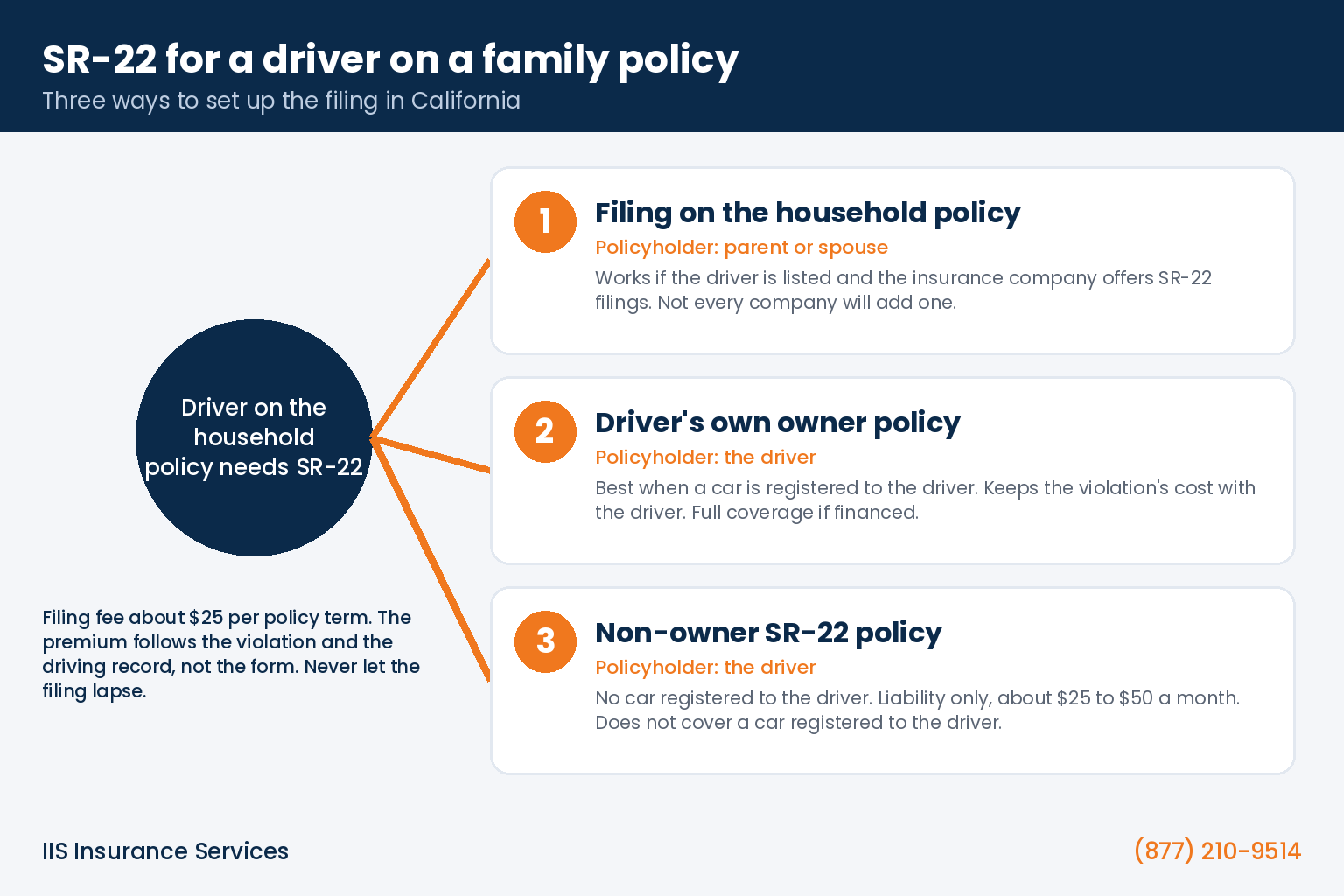
Three ways to set up SR-22 insurance for a driver on a family policy
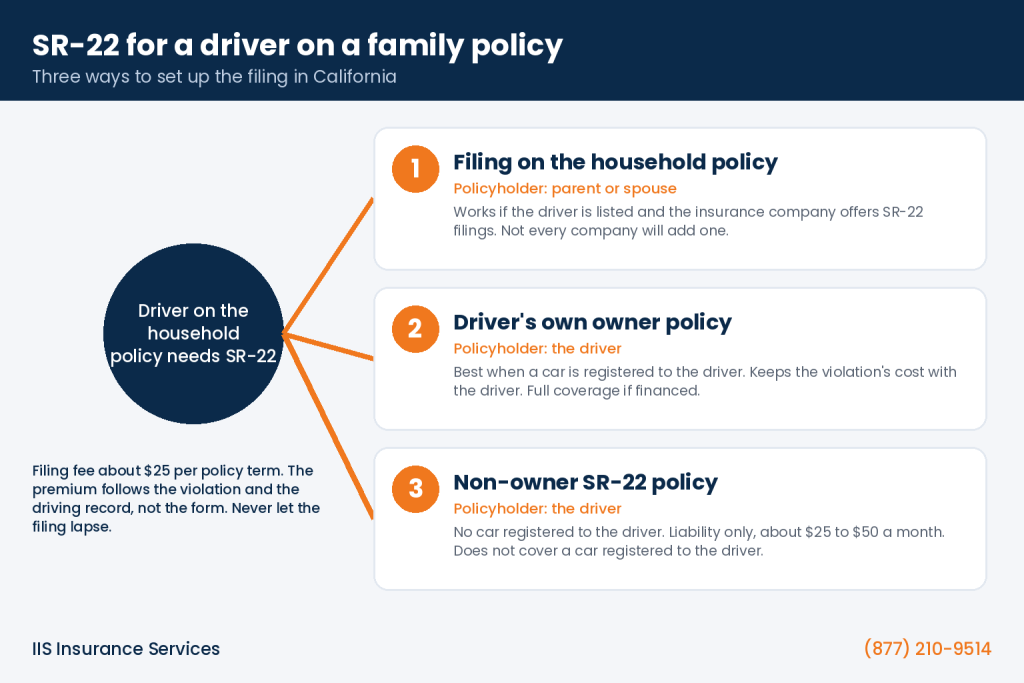
When a driver on a household policy needs an SR-22, there are three ways to set it up, and the right one depends on two facts: whether the driver owns a car, and whether the insurance company that writes the family policy offers SR-22 filings at all.
Option one: the filing goes on the household policy
If the driver is already listed on the family policy and that insurance company offers SR-22 filings, the filing can go on the policy the family already has. The insurance carrier files the certificate with the DMV under the driver’s license number. The policy stays in the policyholder’s name, the driver stays listed, and the certificate simply attaches to that driver. The catch is that not every insurance company offers SR-22 filings, and some will not add one to an existing household policy. We find that out on the first call, before anyone cancels anything.
Option two: the driver gets their own owner policy
If the driver has a car registered in their own name, the cleanest setup is usually their own policy with the SR-22 attached. That keeps the violation’s effect on the premium with the driver who has the violation, and it keeps the family policy as it was. Full coverage is a choice, not a requirement; a lender requires it on a financed car, and it makes sense if the car has real value.
Option three: a non-owner SR-22 for a driver who does not own a car
If the driver does not have a car registered to them, a non-owner SR-22 policy is the third route. It is a liability-only policy in the driver’s name, and the insurance carrier files the SR-22 on it. Non-owner SR-22 premiums with the insurance companies we work with run about $25 to $50 a month. One thing to know before you choose it: a non-owner policy does not cover a car registered to the driver, and the insurance company will ask about the cars in the household. Answer accurately. If the driver later buys a car, the filing moves to an owner policy.
| Setup | Who is the policyholder | Best fit | What to watch |
|---|---|---|---|
| Filing on the household policy | The parent or spouse | Driver is listed, insurance company offers SR-22 filings | Not every insurance company will add one |
| Driver’s own owner policy | The driver | Car is registered to the driver | Full coverage if financed or valuable |
| Non-owner SR-22 policy | The driver | No car registered to the driver | Does not cover a car registered to the driver |
What an SR-22 does to the rest of the household’s car insurance
The honest answer is that the filing itself does very little; the violation behind it does the work. In California, Proposition 103 ties auto rates mainly to the driving record, the annual miles, and the years of driving experience of each driver on the policy. So a driver with a DUI in the past 10 years, or with more than one point, loses the Good Driver Discount for themselves, and the premium for that driver goes up on whichever policy lists them. Credit scores are not used in California auto rates, so there is no credit angle to this.
What families usually want to know is whether the parents’ own rate changes. If the driver stays on the household policy, the household premium includes that driver, so the total goes up. If the driver moves to their own policy, the family policy no longer rates that driver, and the driver carries the cost of their own record. Neither way is wrong. It is a question of who pays and how the family wants to handle it, and we quote both so you can compare real numbers instead of guessing. For the full breakdown of premium, filing fee and broker fee, see our post on how much SR-22 insurance costs in California.
Another situation we have handled in our agency is the parent who wants to keep a young driver on the household policy so the premium is paid from one place, only to learn that the family’s insurance company does not offer SR-22 filings. The family does not have to move the whole household to a new company. The driver can get a non-owner SR-22 or an owner policy on their own, and the parents keep the policy they like.
Getting SR-22 insurance quotes in California without a lapse
Whichever setup you choose, the one rule that matters more than price is this: do not let the filing lapse. If the policy that carries the SR-22 is canceled for any reason during the three-year period, the insurance company notifies the DMV and the driving privilege is suspended again. So if a driver is moving from the household policy to their own, the new filing has to be on the state’s record before the old policy is touched. We handle that order for you, and we usually get the filing to the DMV the same day the policy is bound.
What we need on the call is short: the driver’s name exactly as it appears on their license, the license number, the date of birth, what caused the requirement, and whether there is a car registered to the driver. From there we shop several insurance companies and give you the numbers for the setup, or setups, that fit. The DMV does not send a notice when the three years are over, so before anyone removes the filing later, the driver confirms with the DMV that the requirement has ended. Our post on the best SR-22 insurance in California covers when the three-year period starts and how removal works.
Frequently asked questions
Will an SR-22 make my insurance go up?
The filing itself adds about a $25 fee per policy term with the insurance companies IIS Insurance Services works with; each time the policy renews, the insurance company charges the SR-22 filing fee again. The increase people feel comes from the violation on the driving record, which affects the premium for that driver on any policy that lists them.
Can I get an SR-22 on my parents’ insurance?
Sometimes. If you are listed on the policy and the insurance company offers SR-22 filings, the filing can attach to you on that policy. If the insurance company does not offer them, you can get a non-owner SR-22 or your own policy without moving your parents’ coverage.
Do I need an SR-22 to reinstate my license in California?
The DMV or the court decides that. If your suspension requires proof of financial responsibility, the license is not reinstated until the insurance carrier’s filing is on the DMV’s record, and after a DUI the DMV also charges a reissue fee.
How much does SR-22 insurance cost in California?
It depends on the violation and the record, not on the form. Non-owner SR-22 policies with the insurance companies we work with run about $25 to $50 a month; an owner policy with a DUI costs more. We give real quotes by phone the same day.
Which car insurance company offers the best SR-22 insurance in California?
There is no single company that is best for every record, which is why an agency that shops several insurance companies is useful. IIS Insurance Services compares the companies we work with for your specific violation and tells you the lowest option we find.
Call IIS Insurance Services for SR-22 insurance quotes in California
IIS Insurance Services has been handling SR-22 filings in California since 2009, and we place DUI cases every day. Tell us whether the driver owns a car and who the policyholder should be, and we will quote the setup that fits, bind it by phone, and usually get the filing to the DMV the same day. We help clients in seven languages: English, Spanish, Korean, Russian, Ukrainian, Armenian, and Georgian. Call (877) 210-9514.
Reviewed by George Karapetyan, IIS Insurance Services. CA license #0E94849, agency license #0G56765. Last reviewed October 2026.