

SR22 insurance coverage is one of the most misunderstood parts of getting your license back. In California, an SR-22 is not a special kind of car insurance. It is a form your insurance carrier files with the DMV to prove you carry the state’s required liability coverage. Our main SR-22 page on SR-22 insurance in California covers the filing and pricing. This post answers a narrower question: what does the policy behind the SR-22 actually cover, and what doesn’t it?
You do not automatically need full coverage just because you need an SR-22. Collision and comprehensive are optional unless a lender or lease requires them. The right coverage depends on your car, your budget, and how you drive.
SR22 Insurance Coverage: Does an SR-22 Cover Anything?
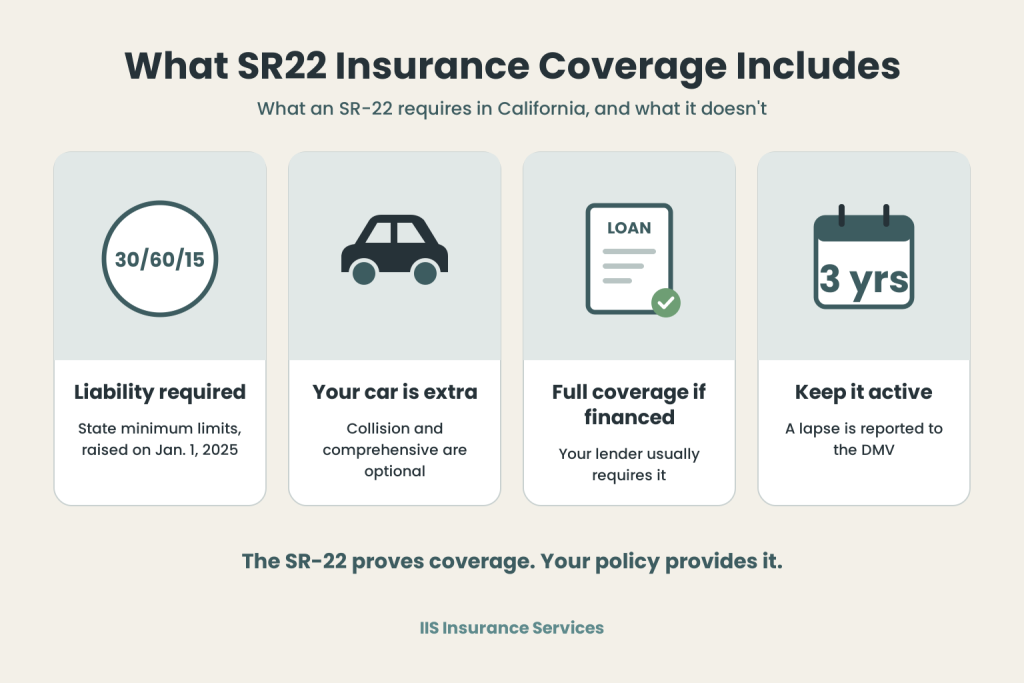
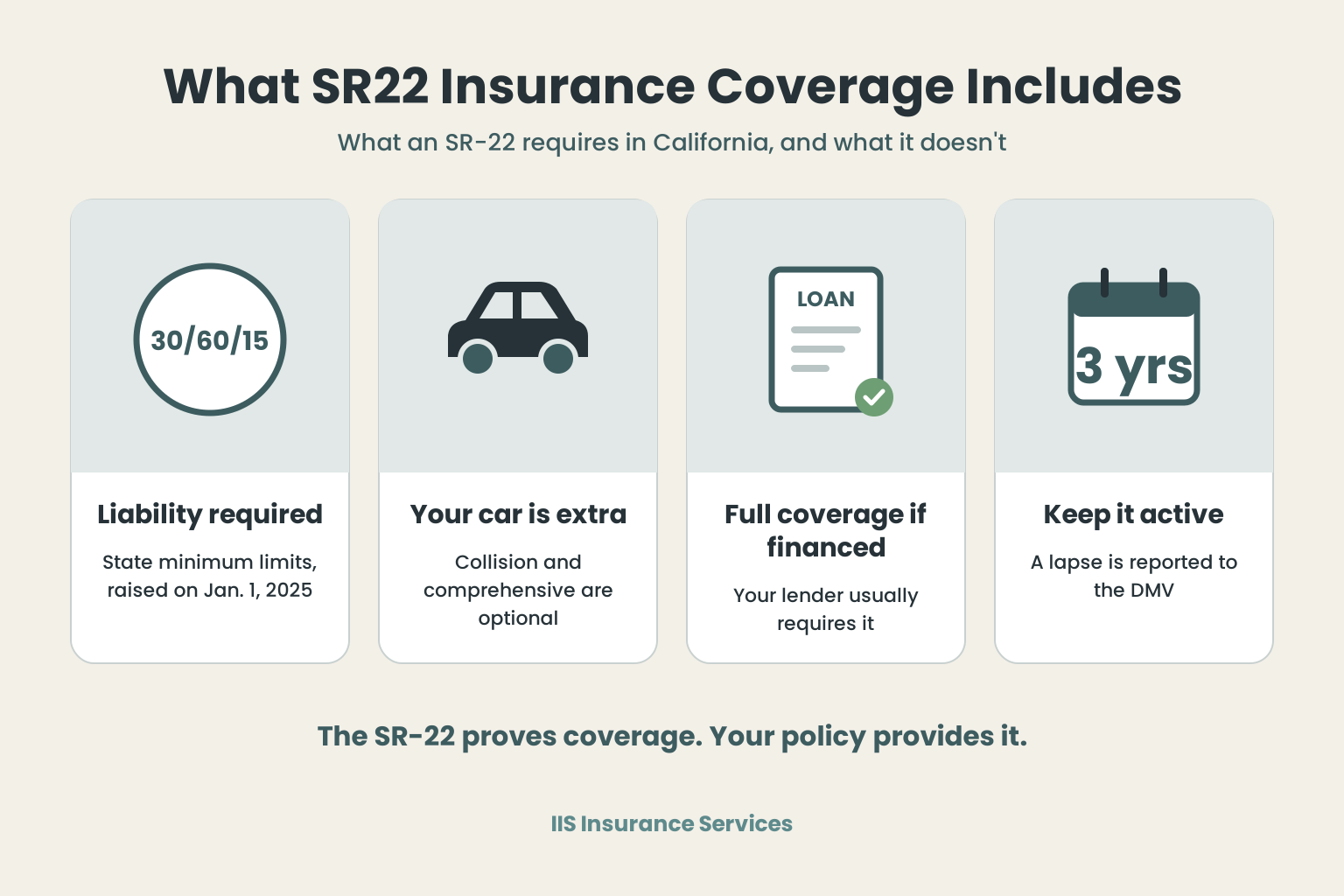
On its own, no. The SR-22 is an official certificate, not coverage. In legal terms it is proof of financial responsibility: the insurance carrier files it with the DMV, and it tells the DMV that an insurance policy with at least California’s minimum liability limits is in force. The coverage comes from the auto insurance policy the SR-22 is attached to.
That policy can be an owner policy on a car you own, or a non-owner policy if you don’t own a car. Either way, the SR-22 only requires liability coverage at California’s minimums. Anything beyond that, like higher limits, collision, or comprehensive, is your choice (or your lender’s requirement), not the DMV’s.
California Liability Limits and What Liability Pays For
California’s minimum liability limits used to be much lower: $15,000 per person, $30,000 per accident, and $5,000 for property damage (15/30/5). Senate Bill 1107 raised them on January 1, 2025. Today the minimums are $30,000 for injury or death to one person, $60,000 for injury or death per accident, and $15,000 for property damage (30/60/15). The same law schedules another increase on January 1, 2035, to 50/100/25. The current 30/60/15 limits are what the SR-22 requires. They are a floor, not a recommendation. A serious accident with a newer car or several injured people can go past those numbers fast, and anything above your limits can come back to you personally.
| Situation | Does liability coverage pay? | Coverage that may apply instead |
|---|---|---|
| Injuries to another driver, passenger, or pedestrian you are at fault for | Yes, up to your bodily injury limits | None needed |
| Damage to another person’s car or property | Yes, up to your property damage limit | None needed |
| Repairs to your own car | No | Collision or comprehensive |
| Your own injuries | No | Medical payments or uninsured motorist coverage |
| Costs above your liability limits | No | Higher liability limits |
| Using your car for business | Usually not under a personal policy | Commercial auto insurance |
Is Full Coverage Required for SR22 Insurance Coverage?
No. The SR-22 only requires liability. “Full coverage” is an informal term for liability plus collision and comprehensive. Collision helps pay for damage to your car after a crash, and comprehensive covers things like theft, vandalism, fire, and falling objects.
Full coverage makes sense when your car has good value, because liability alone won’t repair or replace it. If the car is financed or leased, the lender or leasing company will usually require collision and comprehensive anyway. In that case the full coverage requirement comes from your finance agreement, not from the SR-22. For an older car with low value, liability only is often a reasonable choice.
- The SR-22 requires liability at California’s minimum limits, nothing more.
- Liability pays for injuries and damage you cause to others, not your own car.
- Collision and comprehensive protect your car and are optional unless a lender requires them.
- Higher liability limits protect your savings if an accident is serious.
Does Your Insurance Policy Cover Someone Else’s Car?
That is a policy question, the same as it would be on a regular policy. Having an SR-22 doesn’t add or remove anything. Whether you’re covered depends on your policy terms, whether you had permission, whether you live with the car’s owner, and how often you drive it. If you don’t own a car, a non-owner policy can carry your SR-22 and give you liability coverage when you occasionally borrow one.
Motorcycle owners have a different setup. If you ride a motorcycle, see our post on SR22 motorcycle insurance in California.
Will an SR-22 Raise Your Car Insurance Cost?
The filing itself isn’t what raises your price. The reason behind it is. A DUI, an accident without insurance, or a suspension for too many points tells the insurance company you are a higher risk, and that is what increases the premium. The SR-22 is just the proof that you’re insured.
Non-owner SR-22 policies tend to be the least expensive, commonly about $25 to $50 a month in California. Owner policies cost more because they insure a specific car, and the price depends on the vehicle, your ZIP code, your record, and the coverage you pick. When you compare prices, keep three things separate: the policy premium, any one-time SR-22 filing fee the insurance carrier charges, and the agency’s broker fee. Most SR-22 agencies charge a broker fee, often $200 or more. In California a broker fee is not set by law, has to be disclosed to you in writing before you buy, and may be negotiable. IIS Insurance Services charges broker fees too, but we never turn anyone away and we lower or waive the fee for people in a tough financial situation.
Why Would a Person Need SR-22 Insurance?
The California DMV usually requires an SR-22 after events like these:
- A DUI conviction or DUI-related suspension
- Being in an accident without insurance
- A license suspension for too many points, including several minor violations that add up
- Certain serious violations or a court order
Your DMV notice or court paperwork will say whether you need one and what else is required to reinstate your license.
What Happens If Your SR-22 Insurance Lapses
If your policy cancels, lapses for a missed payment, or isn’t renewed, the insurance carrier has to notify the DMV. That can lead to another suspension, and you may have to start the reinstatement process again. In California the SR-22 usually has to stay on file for three years, so the policy needs to stay active the whole time. The safest approach is to pick a policy you can keep paying, set up automatic payments, and never cancel an old policy before the new one and its SR-22 are in place.
When you’re ready, IIS Insurance Services can usually file your SR-22 the same day. If you’d rather start online, our post on getting cheap SR-22 insurance online walks through the process.
Frequently Asked Questions
Does an SR-22 cover anything?
Not by itself. The SR-22 is a filing that proves you carry insurance. The coverage comes from the auto policy it is attached to, which must have at least California’s minimum liability limits.
What car insurance covers an SR-22?
Any auto policy from an insurance company that offers SR-22 filings in California. That can be an owner policy on your car or a non-owner policy if you don’t own one.
Do I need full coverage to get an SR-22?
No. The SR-22 only requires liability. Collision and comprehensive are optional unless your car is financed or leased.
Does an SR-22 cover me when I drive someone else’s car?
It depends on your policy, the same as with any regular policy. The SR-22 itself doesn’t change what your policy covers.
Will an SR-22 make my insurance go up?
The violation behind the SR-22 is what raises your rate, not the filing itself. Non-owner SR-22 policies in California commonly run about $25 to $50 a month.
What happens if my SR-22 insurance lapses?
The insurance company notifies the DMV, and your license can be suspended again. Keep the policy active for the full SR-22 period, usually three years.
Get the Right SR-22 Coverage
Call IIS Insurance Services at (877) 210-9514. We’ll explain your coverage options in plain language, compare insurance companies for you, and file your SR-22 with the DMV, usually the same day. For the official requirements, check with the California DMV and the California Department of Insurance.
Reviewed by George Karapetyan, IIS Insurance Services. CA license #0E94849, agency license #0G56765. Last reviewed October 2026.