

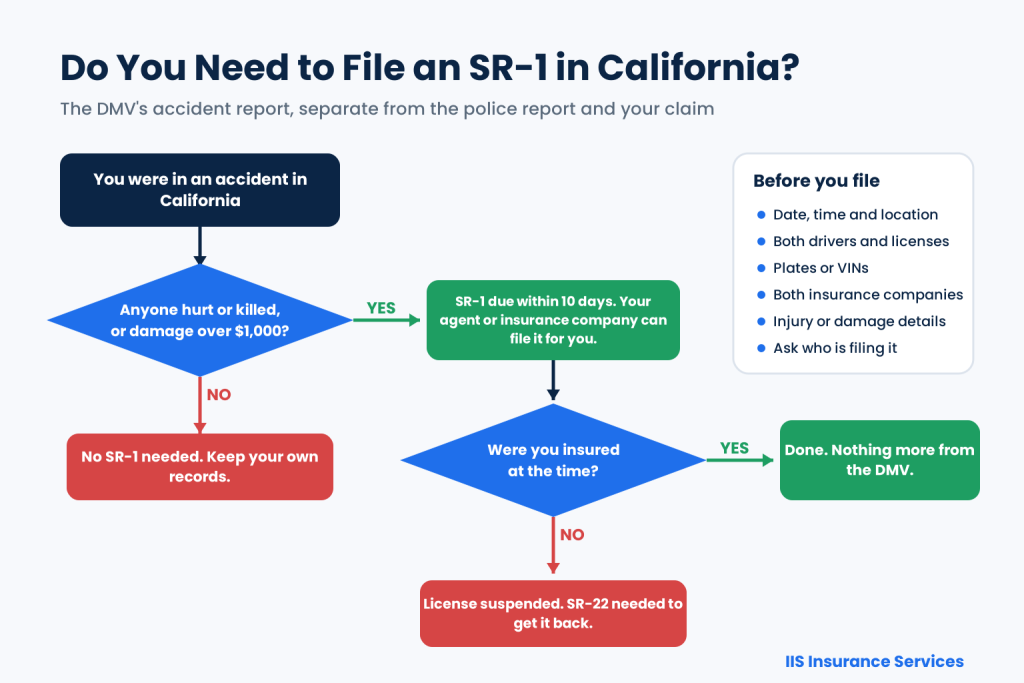
The SR-1 form is California’s accident report to the DMV. It has to be filed within 10 days of any accident where someone was injured or killed, or where property damage was over $1,000. The law puts that duty on the driver, but you don’t have to do it alone. Your insurance agent or insurance company can file the SR-1 for you, and if you had insurance, that is usually the easiest way to handle it. Just ask, and get a yes. The driver who really has to worry about the SR-1 is the one who had no insurance, because the other driver’s report exposes that, and it leads to a suspended license and an SR-22. Our page on SR-22 insurance in California covers that part. This post explains what the SR-1 is, who can file it, and what to do if it falls on you.
SR-1 Form California: What the DMV Accident Report Does
The SR-1 is California’s Report of Traffic Accident. It tells the state that a reportable accident happened and identifies the drivers, vehicles, owners, and insurance information involved. It is not an insurance claim, and it is not a police report. The state uses the form SR-1 for its financial responsibility process, which is how the state checks whether each driver had the required insurance at the time of the accident.
Under California law (Vehicle Code 16000), you must report the accident within 10 days if anyone was killed or injured, no matter how minor the injury, or if property damage was more than $1,000. That threshold is easy to reach. A bumper, a sensor, or one body panel on a newer car can cost more than $1,000 to repair. The duty to file applies whether or not the police came to the scene, whether or not the other driver was at fault, and whether or not you plan to make a claim.
Here is how it works in practice. The law puts the duty on the driver, but the DMV allows your insurance agent, broker, or attorney to file the SR-1 for you. Some insurance companies file it when you report the claim and ask them to. Others don’t, so never assume it was done. Ask your agent or claims adjuster whether they will file it, and treat it as done only when you get a yes. If you were insured and nobody filed, the DMV usually never learns about the accident from your side, which is why most insured drivers never see a problem. If the other driver’s report reaches the DMV, you may get a notice asking for your insurance information, and you respond by the date on the notice. The police report does not count as an SR-1, though. The SR-1 is required in addition to any report made to the police or the CHP.
At IIS Insurance Services, sometimes we see the SR-1 confused with the SR-22. The SR-1 reports an accident. The SR-22 is proof of financial responsibility that your insurance carrier files after a suspension. An SR-1 does not mean you need an SR-22. Driving without insurance at the time of the accident is what leads to one. The uninsured driver also has to file the SR-1 personally, because there is no insurance company or agent to do it.
| Document | What it does | Who files it | What it does not replace |
|---|---|---|---|
| SR-1 | Reports a qualifying accident to the state | The driver, or your insurance agent or insurance company on your behalf | Not a claim and not a police report |
| Police or CHP report | Documents the officer’s investigation | The officer | Does not satisfy the SR-1 requirement |
| Insurance claim | Starts the repair or injury claim | The driver or policyholder | Does not satisfy the SR-1 requirement |
| SR-22 | Proves financial responsibility after a suspension | The insurance carrier | Does not report an accident |
When You Must File the SR-1 Form and What to Gather
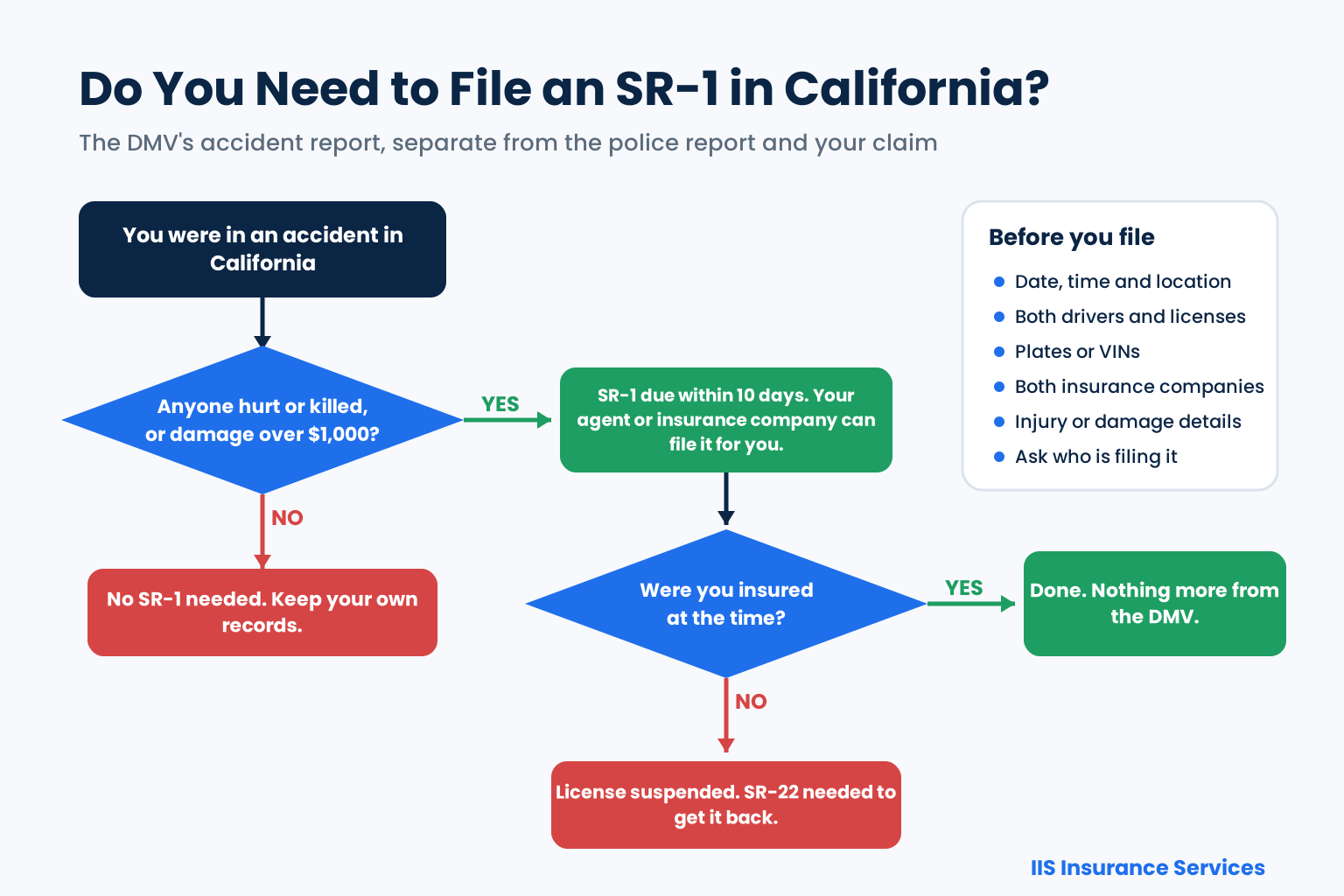
The rule is simple: injury, death, or more than $1,000 in damage means an SR-1 is due, and the deadline is 10 days from the accident. It doesn’t matter if the other driver offers to pay for the repairs privately, or if the damage looks minor. If you are not sure the damage is over $1,000, report it anyway. Reporting an accident that turns out to be under the limit doesn’t hurt you. Missing one that was over it can cost you your license.
Who actually fills out the form depends on your insurance:
- You had insurance. Report the claim, then ask your insurance agent or claims adjuster to file the SR-1 for you. Once they confirm it was filed, you are done. If they say no, or you don’t get a clear answer, file it yourself.
- You had no insurance. You file it yourself, within the 10 days. There is no agent or insurance company to do it for you.
If the SR-1 falls on you, gather these before you start:
- The date, time, and location of the accident
- Your driver license number, and the name, address, and license number of the other driver
- Each vehicle’s license plate or VIN, and the owner’s name if the driver didn’t own the car
- Your insurance company, policy number, and the policy dates
- The other driver’s insurance company and policy number
- A short description of the injury or property damage
If you don’t have some of the other party’s information, the form tells you to write “unk” for unknown or “none” rather than leave it blank. Don’t wait for the police report number or a repair estimate if the 10-day deadline is close. You can file with what you have. The state will not accept an SR-1 sent more than one year after the accident, so late is still better than never, but on time is what keeps your license safe.
The driver who gets in trouble is the one who had no insurance. The DMV learns about the accident from the other driver’s SR-1, sees no insurance on your side, and sends the suspension notice. The drivers who call IIS Insurance Services after an accident are almost always in that situation: no policy on the day of the crash, and a DMV letter a few weeks later.
Another common mistake is leaving out your own insurance information or getting the company name wrong. That section is how the state confirms you were insured. Give the full name of the insurance company that issued the policy, not just the agency you bought it from, and make sure the policy was in force on the day of the accident. If you can’t find the policy number, call your agent before you file.
File the SR-1 With the California DMV: Address, Insurance and Common Questions
If you are filing it yourself, you can file the SR-1 online through the DMV Virtual Office, which is the fastest option, or print the form and mail it to the Department of Motor Vehicles, Insurance Unit, Mail Station J237, P.O. Box 942884, Sacramento, CA 94284-0884. Paper reports take longer to process. Keep a copy of what you send and any confirmation you receive.
After the DMV reviews the SR-1 reports from both drivers, one of two things happens. If you were insured, nothing more is needed from you on the state side. If you were driving without insurance, the DMV will suspend your license for up to four years, no matter who was at fault. You can get it back during the last three years of that suspension by having your insurance carrier file an SR-22 with the DMV and keeping it on file for three years. Our post on SR22 after an accident without insurance in California explains that process step by step.
An SR-1 does not decide fault, and it does not by itself suspend anyone’s license. It gives the state what it needs to check insurance. The police report is still useful evidence for your claim, and your insurance company still needs its own claim report. Each one does a different job, and none of them replaces the other.
- An SR-1 is due within 10 days if anyone was hurt or killed, or damage is over $1,000.
- If you were insured, ask your insurance agent or insurance company to file it for you, and get a yes before you consider it done.
- If you were uninsured, file it yourself online through the DMV Virtual Office or by mail.
- It is due even if you were not at fault or the police responded.
- Include complete insurance information for yourself and the other driver.
- Keep a copy of the form and your confirmation.
If the accident leads to an SR-22 requirement, our post on the best SR-22 insurance in California explains when the three years start and what a lapse does to them.
Frequently Asked Questions
Who fills out the SR-1 form in California?
The law puts the responsibility on the driver, but the DMV lets your insurance agent, broker, or attorney file it for you. If you had insurance, ask your agent or claims adjuster to file it and confirm that they did. If you were uninsured, or nobody will file it for you, you file it yourself.
What happens if you don’t file the SR-1?
If you were insured and nobody filed, the DMV usually never learns about the accident from your side, so most insured drivers never see a problem. If the DMV does hear about it from the other driver, you may get a notice asking for your insurance information, and the DMV can suspend a license for not reporting. If you were uninsured, the suspension comes from the lack of insurance. The state also won’t accept an SR-1 filed more than one year after the accident.
Do I need an SR-1 if the accident was not my fault?
Yes. The requirement applies to every driver in a qualifying accident, regardless of fault. If you were insured, your insurance agent or insurance company can file it for you.
Is an SR-1 the same as an SR-22?
No. The SR-1 reports the accident. The SR-22 is proof of insurance your insurance carrier files if your license is suspended, usually because you were uninsured at the time of the accident.
Can I submit the SR-1 online?
Yes. The DMV Virtual Office has an online SR-1. You can also mail the paper form, but paper takes longer to process.
Need Help After an Accident?
If you were driving without insurance when the accident happened, or the DMV has suspended your license, call IIS Insurance Services at (877) 210-9514. We have been placing SR-22 filings in California since 2009, we can usually start coverage and have the SR-22 filed the same day, and we can help you in seven languages. For the SR-1 form itself and the official filing rules, go to the California DMV.
Reviewed by George Karapetyan, IIS Insurance Services. CA license #0E94849, agency license #0G56765. Last reviewed October 2026.