

Buying non-owner SR-22 insurance online is quick. You give your license number, the carrier files the SR-22 with the DMV, and you are legal again without owning a car. What the online checkout does not tell you is what to do when your situation changes, and for a lot of our clients it changes the same way: somewhere in the three years, they buy a car. The switch is not hard, but the order of the steps matters, because the DMV is watching the filing and a gap of even a day can put you back on suspension. This post covers how to make the change, what we see go wrong, and what the new policy costs. For the basics on the non-owner policy itself, see our page on non-owner SR-22 insurance in California.
Can I keep a non-owner SR-22 if I own a car?
No. A non-owner policy covers you when you drive a car you do not own. It does not cover a car registered to you. Once the car is in your name, you need an owner policy, and the SR-22 moves to that policy.
This matters for the DMV too. The SR-22 is a certificate the insurance carrier files to show you have proof of financial responsibility. If you buy a car and keep driving it on a non-owner policy, you are driving a car that is not insured by that policy. An accident in that car is an uninsured accident, and that is the fastest way to add a second suspension on top of the first.
Switching from non-owner SR-22 insurance to an owner policy
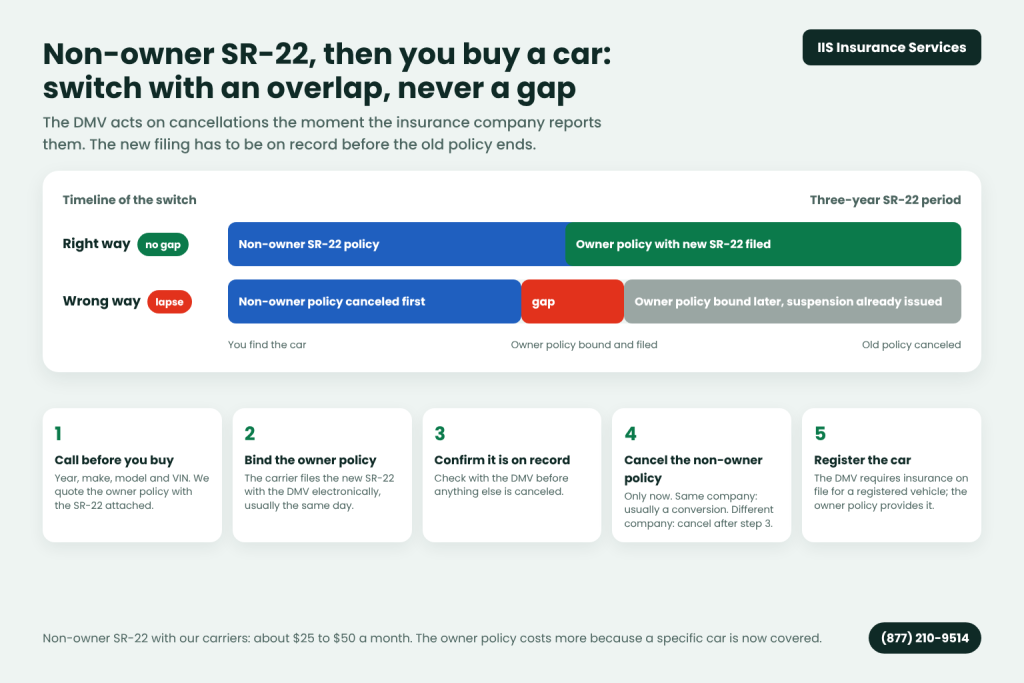
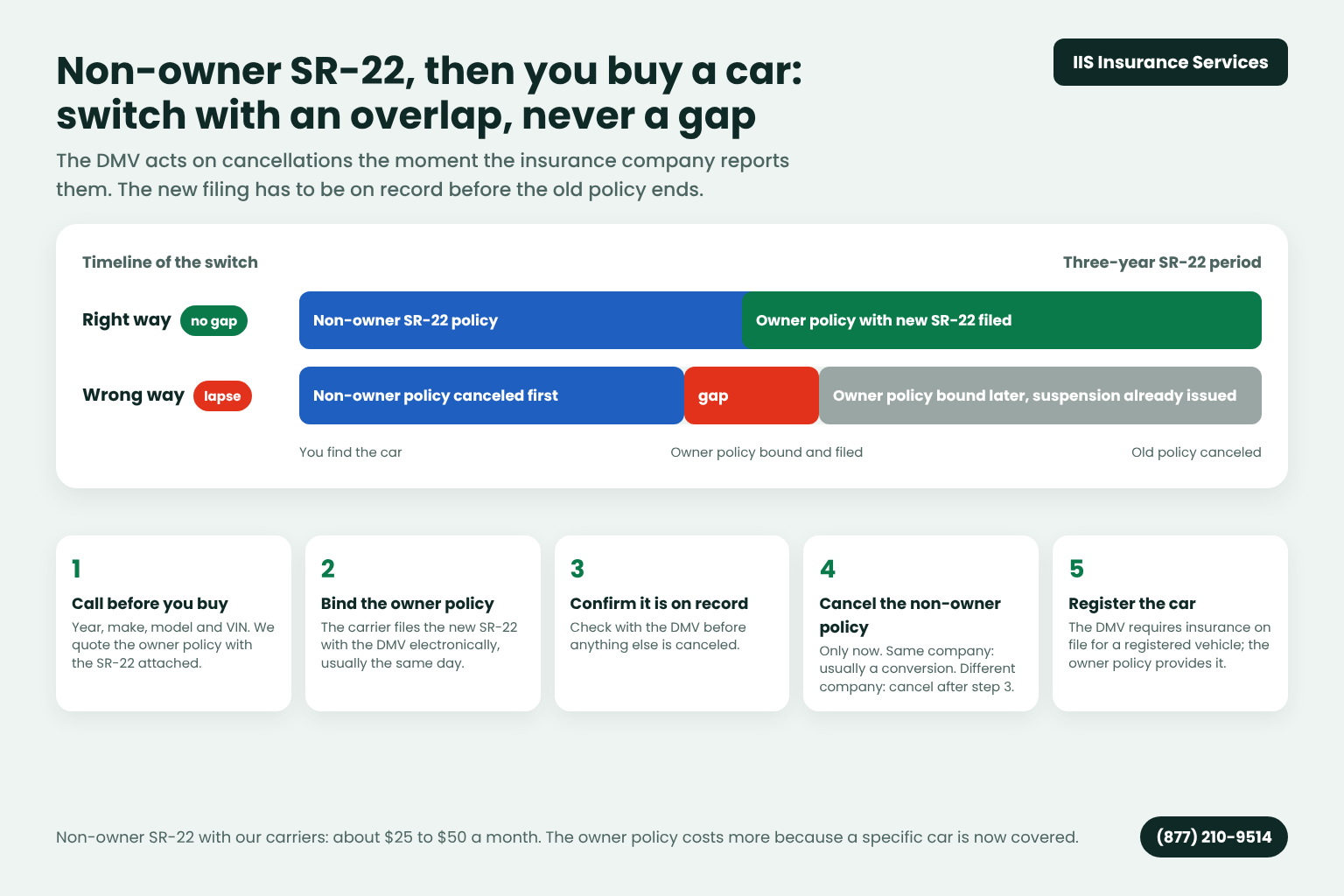
Here is the order that works. The DMV’s own guidance on proof of financial responsibility says to make sure new proof is on file before canceling the old policy, and that is the rule that drives every step below.
- Call before you buy, or at least before you drive the car home. Give us the year, make, model and VIN of the car you are looking at. We can quote the owner policy with the SR-22 attached before you sign for the car.
- Bind the owner policy with the SR-22 filing. The insurance carrier files the new SR-22 with the DMV electronically. We usually get filings to the DMV the same day.
- Confirm the new filing is on record. Do not skip this. The DMV acts on cancellations when the insurance company reports them, so the new proof has to land first.
- Then cancel the non-owner policy. If both policies are with the same insurance company, this is usually a conversion rather than a cancel and rebind. If they are with different companies, cancel the old one only after step 3.
- Register the car. The DMV requires insurance on file for a registered vehicle, and the owner policy gives you that.
The one thing you do not do is cancel the non-owner policy first “to save money” and then shop for the owner policy. That gap goes to the DMV as a lapse.
| Step | Who does it | What to have ready |
|---|---|---|
| Quote the owner policy | IIS Insurance Services | Year, make, model, VIN, your license number |
| File the new SR-22 | The insurance carrier | Nothing; the carrier files electronically |
| Confirm the filing is on record | You, with the DMV | Your driver license number |
| Cancel the non-owner policy | You or your agent | The new policy number |
| Register the car | You, at the DMV | Proof of insurance from the owner policy |
What the new policy costs compared to the non-owner SR-22
A non-owner SR-22 runs about $25 to $50 a month with the insurance companies we work with. An owner policy costs more, because now a specific car is covered, and the price depends on the same things any California policy depends on: your driving record, annual miles, and years of driving experience. The violation that put the SR-22 on your record is already priced in; the form itself does not change the premium. The SR-22 filing fee with our carriers averages about $25, usually one time.
Two choices affect the number most:
- Liability only or full coverage. The SR-22 only requires state minimum liability, $30,000 per person, $60,000 per accident for injury, and $15,000 for property damage. If the car has real value or a lender is involved, full coverage makes sense. If it is an older car you paid cash for, liability only keeps the premium close to what you were paying.
- Which car you buy. A car that is cheap to repair and does not attract theft is cheaper to insure. If you are deciding between two cars, ask for both quotes before you choose. Our post on how to get an SR-22 without a car explains the non-owner side, and our post on the cheapest non-owner SR-22 insurance covers what drives that price.
Broker fees
Most SR-22 agencies charge a broker fee, and $200 and up is common. IIS Insurance Services charges broker fees too. We disclose the fee in writing before you buy, and we lower or waive it for drivers in hardship.
Mistakes we see with the switch
Sometimes a client buys the car on a Saturday, drives it for a week, and calls on the following Friday. The non-owner policy never covered that car. If nothing happened, the fix is just the switch. If something did happen, the claim is denied and the DMV may hear about it from the other driver’s accident report.
Sometimes a client cancels the non-owner policy the same day they bind the owner policy with a different company, and the cancellation reaches the DMV before the new filing does. The DMV sees a lapse and suspends. A day or two of overlap is cheap compared to a reinstatement.
Sometimes a client bought the non-owner policy online, never spoke to anyone, and does not know who to call when the car shows up. That is the real cost of a checkout page. Whoever you buy from, make sure there is a person you can reach when something changes.
Sometimes a client adds the car to a family member’s policy instead of their own. That can work for coverage, but the SR-22 has to be filed under your name and your license number, so the policy has to list you as a driver and the carrier has to file for you specifically. Tell the agent the SR-22 is yours before anything is bound.
Frequently asked questions
Can I get non-owner SR-22 insurance online?
Yes, many agencies sell it online. We quote and bind non-owner SR-22 policies by phone, usually the same day, and the carrier files the SR-22 with the DMV electronically. You will need your driver license number and the details of the suspension.
Can I get a non-owner SR-22 if I own a car?
No. A non-owner policy is for drivers who do not own a vehicle. Once a car is registered to you, you need an owner policy with the SR-22 attached.
Do I need separate car insurance if I have an SR-22?
The SR-22 is not insurance. It is a certificate attached to a policy. When you buy a car, the policy that covers the car is the one that carries the SR-22. You do not keep two policies.
What happens if you don’t carry an SR-22 the whole time?
The insurance company notifies the DMV when the policy cancels, and the DMV suspends your license. You then need a new filing to clear it, and the DMV decides how the earlier months count.
Is a non-owner SR-22 cheaper than a regular SR-22?
Usually, because no specific car is covered. Non-owner policies with our carriers run about $25 to $50 a month. An owner policy costs more, and how much more depends on the car and the coverage you choose.
Buying a car soon? Call before you sign
IIS Insurance Services binds multiple SR-22 policies every day and usually gets the filing to the DMV the same day. Give us the VIN and we will quote the owner policy before you commit to the car. We shop several insurance companies and help clients in seven languages: English, Spanish, Korean, Russian, Ukrainian, Armenian, and Georgian. Call (877) 210-9514.
Reviewed by George Karapetyan, IIS Insurance Services. CA license #0E94849, agency license #0G56765. Last reviewed October 2026.