

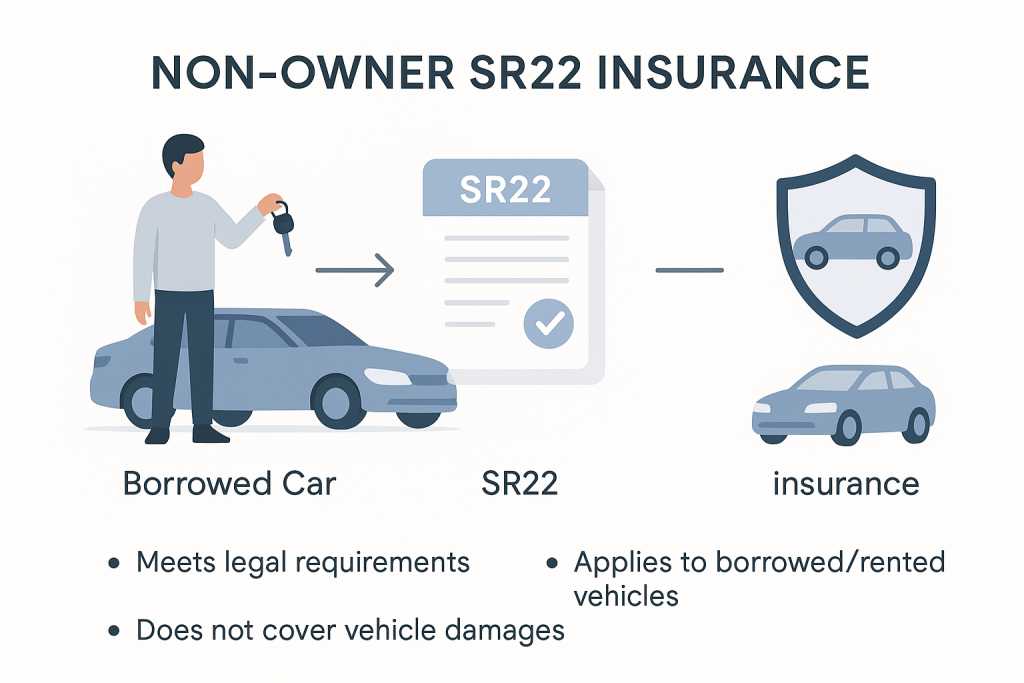
You may still need insurance after a license suspension or serious traffic violation, even if you do not own a vehicle. If you borrow a friend’s car, rent occasionally, or plan to drive after reinstating your license, non-owner SR22 insurance for driving borrowed cars may help you meet California’s financial responsibility requirements.
An SR22 is not a separate insurance policy. It is a certificate filed by an insurance company with the California Department of Motor Vehicles to confirm that you carry the required liability insurance. A non-owner policy provides the underlying coverage when no car is registered in your name.
This arrangement can help you restore or maintain your driving privileges without insuring a specific vehicle. However, the policy has limits. It generally covers your liability for injuries or property damage you cause to others, not damage to the borrowed car or your own injuries.
Understanding these limits before you drive can help you avoid coverage gaps, unexpected costs, and further problems with your license.
How Non-Owner SR22 Insurance Works Without Your Own Car
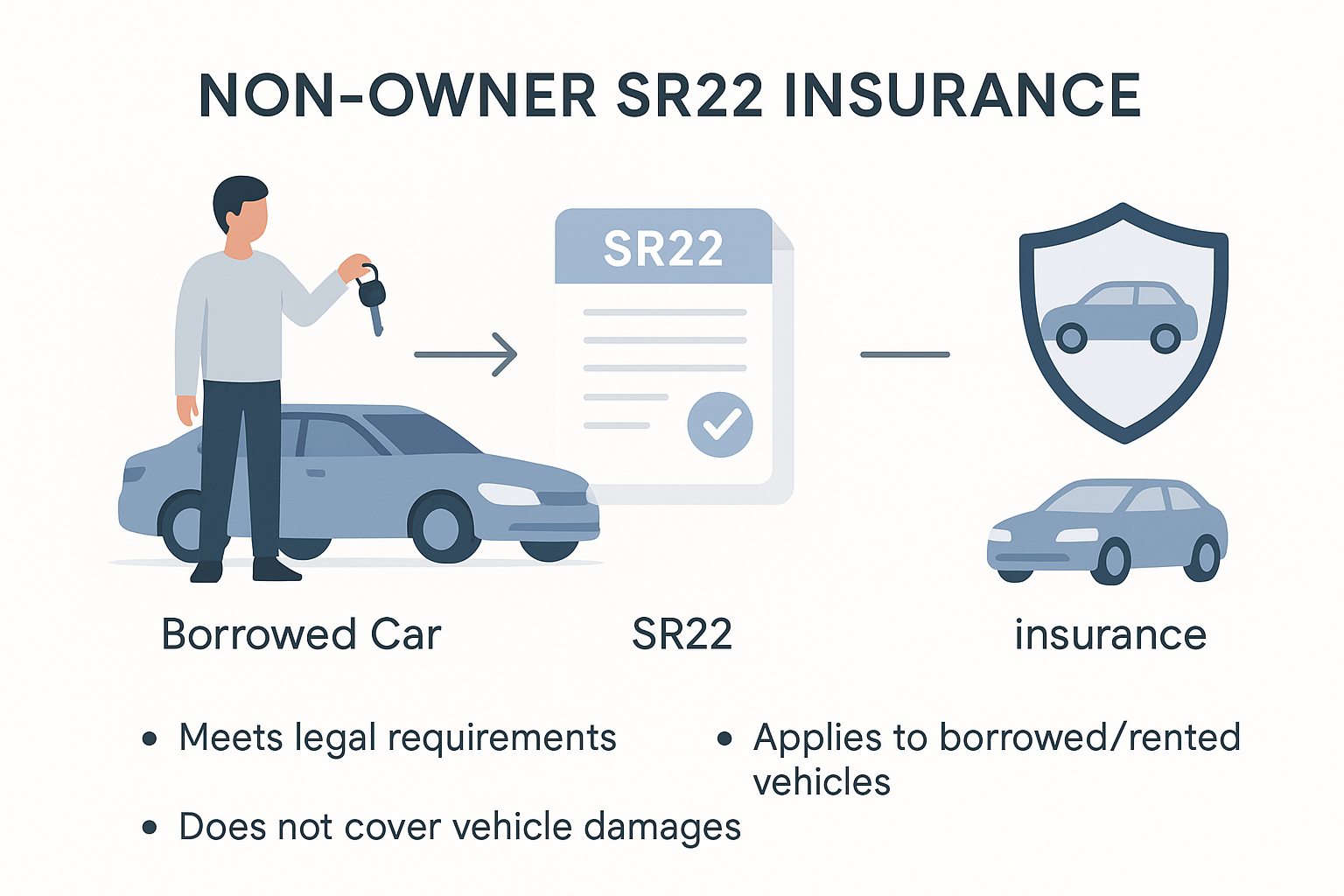
Non-owner SR22 insurance combines two separate elements. The non-owner auto policy provides liability coverage, while the SR22 form serves as proof that the policy meets the state requirement.
After you purchase qualifying insurance, your provider files the SR22 with the California DMV on your behalf. The filing connects your insurance coverage to your driving record rather than to a particular car. This allows someone without a vehicle to show financial responsibility and complete the insurance portion of the license reinstatement process.
A non-owner policy may apply when you occasionally drive a vehicle that belongs to someone else. Depending on the policy terms, that could include a friend’s car, a relative’s vehicle, or a rental car.
The coverage generally follows you as the named insured. It does not turn the borrowed vehicle into an insured car under your policy. The owner’s auto insurance remains important, and it will often respond first when an accident involves the owner’s vehicle. Your non-owner coverage may then provide secondary liability protection, subject to its limits, exclusions, and the circumstances of the claim.
California drivers who must carry an SR22 are generally required to maintain continuous insurance for the period specified by the DMV or court. IIS Insurance Services notes that this period is commonly three years, although the exact requirement depends on the individual case. A lapse or cancellation can be reported to the DMV and may result in another suspension.
The SR22 requirement is connected to your driving history, not whether you currently own a car. Selling your vehicle does not automatically remove the filing requirement.
When Non-Owner Car Insurance May Fit Your Situation
A non-owner policy is intended for people who do not own a vehicle and do not have regular access to the same car. It can be useful when you still need to drive occasionally or keep an active SR22 filing.
Common situations include:
- You need to reinstate a suspended license. A court or the DMV may require proof of insurance after a DUI, uninsured accident, driving without insurance, or another qualifying violation.
- You borrow cars occasionally. You may use a friend’s vehicle for an appointment, borrow a relative’s car for a weekend, or drive different vehicles at irregular intervals.
- You rent vehicles. A non-owner policy may provide liability protection while you rent, although it generally does not replace a rental company’s collision damage waiver or cover damage to the rental itself.
- You are temporarily between vehicles. You may have sold your car, lost it in an accident, or decided to rely on public transportation while planning a future purchase.
- You want to avoid a lengthy insurance lapse. Continuous coverage can matter when insurers review your history and calculate future premiums.
A non-owner policy may not be suitable when you live with someone whose vehicle you drive regularly. Cars owned by household members are commonly excluded because they are considered readily available for your use. In that situation, you may need to be added to the vehicle owner’s policy.
The same concern applies when you regularly use one specific car, keep a borrowed vehicle at your home, or have routine access to a company vehicle. A standard auto policy, household policy endorsement, or commercial policy may be a better match.
Non-owner insurance also is not designed for paid driving activities. Delivery work, rideshare services, courier services, and other business uses may be excluded from personal auto insurance. Tell the agent exactly how you expect to use borrowed vehicles so the policy can be evaluated against your actual driving habits.
Liability Coverage for Borrowed and Rented Cars
Non-owner insurance primarily provides liability coverage for damage or injuries you cause to other people while operating an eligible vehicle. In California, policies used for an SR22 filing must satisfy the state’s applicable minimum financial responsibility requirements.
As of January 1, 2025, California’s minimum automobile liability limits are commonly expressed as 30/60/15:
- $30,000 for bodily injury or death to one person
- $60,000 for bodily injury or death to multiple people in one accident
- $15,000 for property damage in one accident
These limits are minimum requirements rather than a promise that every accident-related expense will be fully paid. Medical costs, vehicle repairs, and legal claims can exceed minimum coverage limits. An agent can explain whether higher liability limits are available and appropriate for your circumstances.
The following table shows how coverage commonly works. Actual protection depends on the policy, the vehicle owner’s insurance, and the facts of the claim.
| Driving Situation | What Non-Owner Coverage May Pay For | What It Usually Does Not Cover | Points to Check |
|---|---|---|---|
| Borrowing a friend’s car | Bodily injury and property damage you cause to others | Damage to the borrowed car and your own injuries | The owner’s policy may respond first |
| Renting a vehicle | Liability claims involving other people or property | Damage, theft, or loss of the rental car | Review the rental agreement and optional protection |
| Driving a family member’s car occasionally | Eligible third-party liability claims | Regular use of a household vehicle | Household and regular-use exclusions may apply |
| Using a vehicle for work | Limited personal-use claims, if allowed | Delivery, rideshare, courier, or other commercial activity | Commercial coverage may be required |
| Driving an employer’s vehicle | Liability not covered elsewhere, depending on policy terms | Damage to the work vehicle and excluded business uses | Confirm the employer’s insurance and permission rules |
Non-owner policies generally do not provide collision or comprehensive coverage because no specific vehicle is insured. They also commonly exclude:
- Repairs to the car you are driving
- Theft, vandalism, fire, or weather damage to that car
- Your medical expenses following an accident
- Personal belongings damaged or stolen from the vehicle
- Cars you own or regularly use
- Vehicles owned by members of your household
- Unauthorized, excluded, or commercial driving
Optional coverage may vary by insurer. Some policies may offer uninsured or underinsured motorist protection or medical payments coverage, while others may be limited to basic liability. Review the declarations, endorsements, and exclusions instead of assuming that all non-owner policies work the same way.
What Happens When You Borrow Someone Else’s Vehicle
Permission and frequency matter when you borrow a car. The vehicle owner should know that you are driving and should confirm that their policy permits you to use the vehicle.
Auto insurance often follows the car first. If you cause an accident in a friend’s vehicle, the owner’s insurance may provide the primary liability coverage. Your non-owner insurance may apply after those limits are exhausted, provided the accident and vehicle qualify under your policy.
That does not mean every borrowed-car accident will be covered. A claim may be denied or limited when:
- You did not have permission to use the vehicle.
- The car belongs to someone in your household.
- You use the same borrowed vehicle frequently.
- The vehicle is available to you whenever you want it.
- You were driving for a delivery service, rideshare company, or other business purpose.
- The vehicle type is excluded under the policy.
- Your license was not valid at the time of the accident.
- The policy had lapsed or been canceled.
Rental vehicles require a separate review. Your non-owner policy may provide liability coverage, but it usually does not pay for physical damage to the rental. The rental company may offer a collision damage waiver, supplemental liability protection, personal accident coverage, or personal effects protection.
Credit card benefits may provide limited rental car protection in some circumstances, but those programs have separate eligibility rules, exclusions, and claim procedures. They should not be treated as an automatic substitute for liability insurance or the rental company’s protection.
Before using a borrowed or rented car, confirm who owns it, how often you will drive it, what the owner’s policy covers, and whether your non-owner insurance applies. A short conversation before you take the keys can prevent a difficult dispute after an accident.
Filing an SR22 and Managing the Cost of Coverage
Getting non-owner SR22 insurance normally begins with an insurance application. The agent or insurer will review your driving record, filing requirement, address, prior coverage, expected vehicle use, and other rating information.
The process generally follows these steps:
- Confirm the filing requirement. Review any DMV notice, court order, or reinstatement document so you know which filing is required and how long it must remain active.
- Explain your vehicle situation. Tell the agent whether you own a car, live with a vehicle owner, regularly use one vehicle, rent cars, or drive for work.
- Compare qualifying policies. Review the liability limits, exclusions, payment schedule, filing fee, and total premium rather than choosing based only on the first monthly payment.
- Activate the insurance. Pay the required amount and confirm the policy’s effective date before driving.
- Have the SR22 filed. Your insurance provider will file the certificate with the California DMV. Electronic filing may allow the DMV to receive it quickly.
- Maintain uninterrupted coverage. Pay on time, update your contact and payment information, and speak with your agent before changing or canceling the policy.
The cost of non-owner SR22 coverage varies. The SR22 filing fee itself may be modest, but the underlying premium reflects the risk associated with your driving history.
Pricing can be affected by your age, ZIP code, violation history, prior claims, insurance lapses, required liability limits, filing period, and the insurance company offering the policy. A DUI or serious conviction may have a larger effect than the filing charge.
You may be able to control costs by comparing several insurers, maintaining continuous coverage, selecting limits that fit your situation, paying the policy in full when practical, and asking about approved discounts. Completing a defensive driving or DUI education program may also help in some cases, although eligibility varies.
Do not reduce costs by giving incomplete information about who owns the cars you use or how frequently you drive them. A cheaper policy provides little value if its exclusions prevent it from responding to a claim.
Get Help With Non-Owner SR22 Insurance in California
Non-owner SR22 insurance can provide a practical route forward when you need to satisfy a filing requirement but do not own a car. The right policy can establish proof of financial responsibility and provide liability protection when you occasionally borrow or rent an eligible vehicle.
The policy must still match the way you actually drive. Regular access to a household car, frequent use of one vehicle, business driving, or a need for physical damage coverage may call for a different solution.
IIS Insurance Services has helped California drivers compare SR22, non-owner, and high-risk auto insurance options since 2009. Its agents can review your filing requirement, explain available coverage, compare rates from multiple insurance companies, and submit an SR22 electronically to the California DMV.
Request a quote from IIS Insurance Services to discuss your driving situation, confirm whether a non-owner policy is appropriate, and arrange the coverage needed to move forward.