

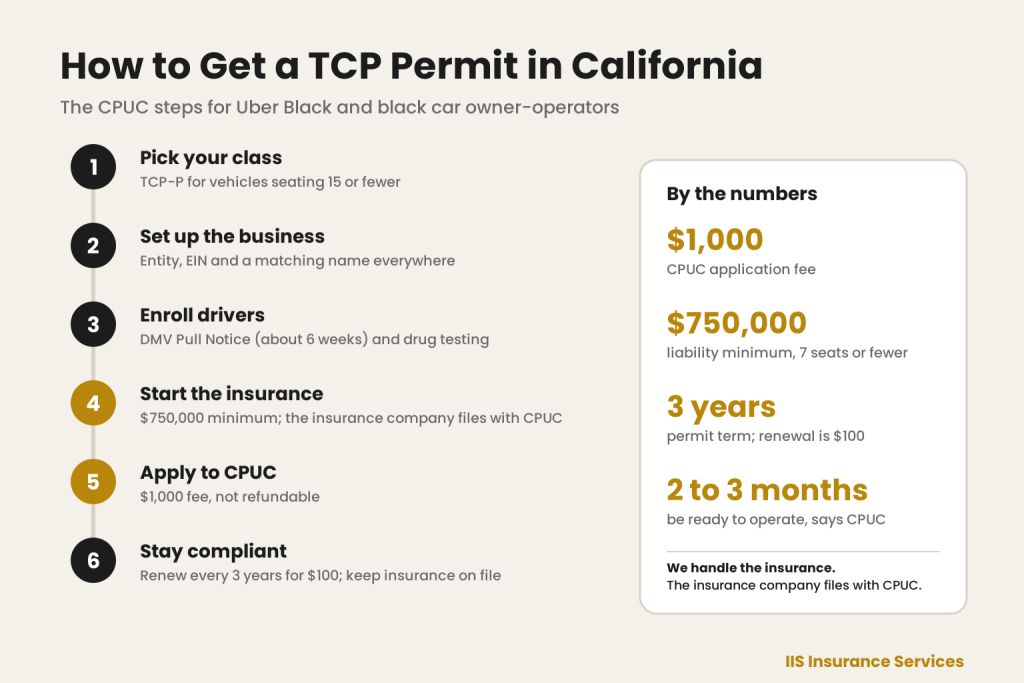
To get a TCP permit in California, you apply to the California Public Utilities Commission (CPUC), meet its business and safety requirements, and have commercial insurance in place before the permit is issued. The same process applies to Uber Black drivers and to anyone starting a limousine, black car, or other prearranged passenger service. Our page on Uber Black and limo insurance in California covers the commercial insurance side. This post walks through the permit itself: which one you need, what to prepare, what it costs, and how the insurance filing works.
One thing to know up front: IIS Insurance Services handles the insurance. We don’t file with the CPUC. The insurance company files your proof of coverage with the CPUC electronically once your policy starts.
How to Get a TCP Permit in California: Know Which Authority You Need
“TCP” stands for Transportation Charter Party. A charter-party carrier takes passengers on a prearranged basis, which is how Uber Black, limousine, and black car services work. It is not a taxi picking up street hails, and it is not a fixed-route bus. The CPUC issues the operating authority, reviews the application, and requires ongoing compliance, including the insurance filing.
The CPUC issues several classes of charter-party authority, and most Uber Black owner-operators need the simplest one:
- TCP-P permit: charter service using only vehicles that seat 15 or fewer passengers. This is the one most Uber Black and black car owner-operators apply for.
- Class B certificate: charter service within 125 air miles of your home terminal.
- Class A certificate: charter service between any points in the state, plus round-trip sightseeing.
- Class C certificate, S permit and Z permit: balloon, rafting and ski operators; round-trip sightseeing; and specialized services not offered to the general public.
Airport Permits, USDOT Registration and Your City License
Your TCP permit is not the only approval you may need. Airports run their own commercial ground transportation programs, so LAX and other airports require a separate permit, placard, or decal before you can pick up on airport property. Our post on the LAX airport permit for Uber Black and limo drivers covers that step. If you plan to cross state lines, federal motor carrier rules and a USDOT number may also apply. The CPUC permit covers prearranged passenger work inside California, and nothing else.
| Authority | Who issues it | What it covers | Check before you apply |
|---|---|---|---|
| TCP-P permit | CPUC | Prearranged passenger service in vehicles seating 15 or fewer | The class that matches your vehicles and service |
| Airport permit | Each airport | Pickups on airport property | Fees, staging rules, and vehicle standards at each airport |
| USDOT number | Federal | Trips that cross state lines | Only needed for interstate work |
| City business license | Your city | Operating a business in that city | Required in most California cities |
Prepare Your Business, Vehicles and Compliance Records Before You Apply
The applications we see get delayed at IIS Insurance Services almost always have the same problem: the name on the insurance policy doesn’t match the name on the CPUC application, so the filing bounces. Match everything to one entity name before you start.
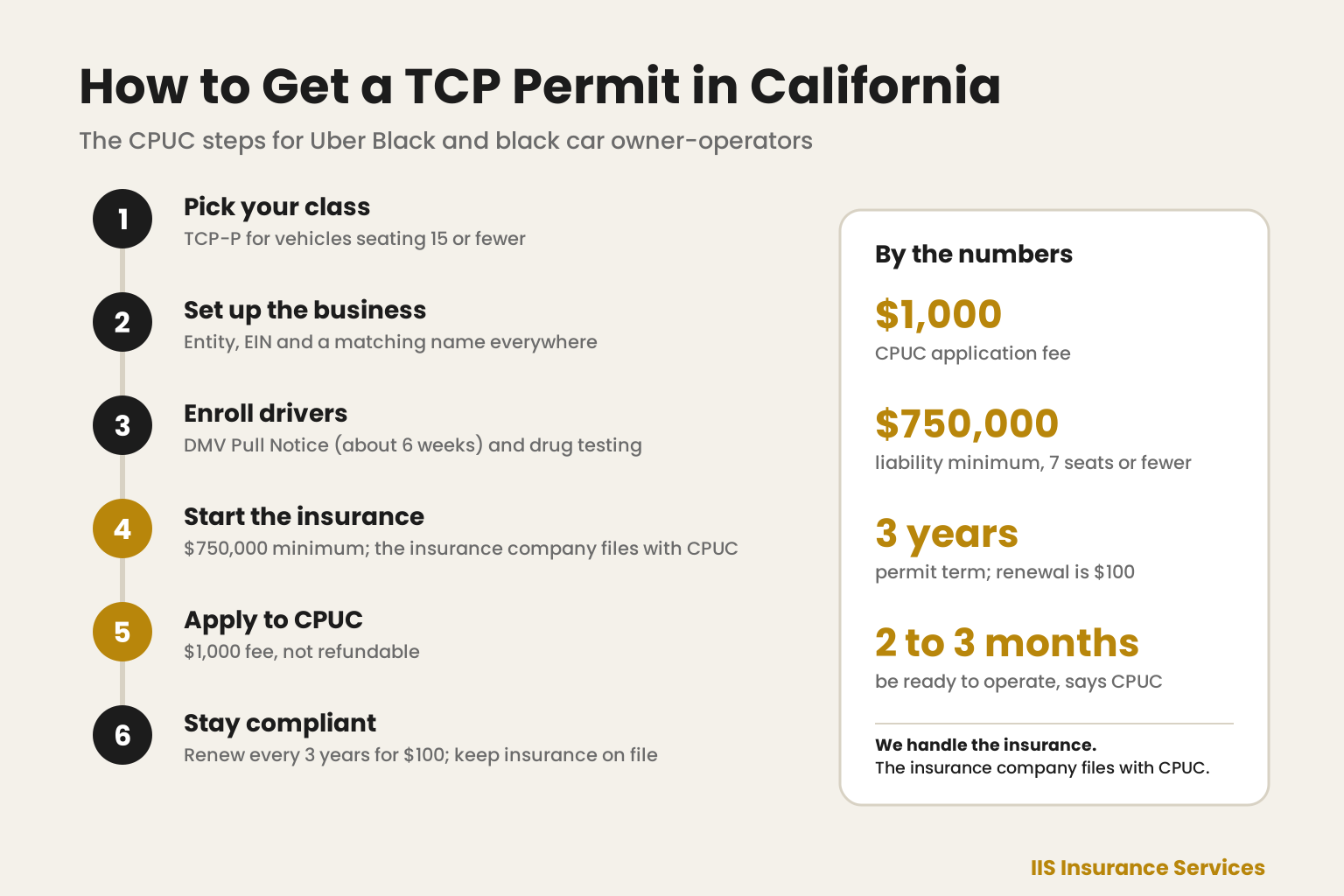
The CPUC itself advises against applying unless you can start operating within two to three months, because the permit comes with ongoing requirements the day it is issued. Get these pieces in order first, and the application goes faster.
Your business entity. You can apply as an individual, an LLC, or a corporation. Whatever you choose, the name on the application, the insurance policy, the vehicle registration, and your Secretary of State records all have to match. Keep your EIN, business address, and any DBA filings together.
Your vehicle roster. List every vehicle you plan to put under the permit: year, make, model, VIN, license plate, and seating capacity. The CPUC asks for vehicle information on Form PL 664 and for DMV commercial registration. If a vehicle is leased, confirm the lease allows commercial passenger use. The vehicle you list is the vehicle the insurance company has to accept, so check that it qualifies for Uber Black before you put it on the roster.
Pull Notice, Testing Program and Workers’ Compensation Filing
DMV Employer Pull Notice program. Every applicant for passenger carrier authority has to enroll in the Employer Pull Notice program (Form INF 1104). It sends you, as the permit holder, a copy of each driver’s record and reports any change, like a new ticket or suspension. The CPUC says the Pull Notice contract can take about six weeks to arrive, so start this early.
Drug and alcohol testing program. Charter-party carriers have to be enrolled in a controlled substance and alcohol testing program. The CPUC requires you to use a testing consultant it has accepted and approved, so ask for that list before you sign up with anyone.
Workers’ compensation. If you have employees, your insurance company has to file workers’ compensation coverage with the CPUC electronically. An owner-operator with no employees doesn’t need that filing, but still has to enroll in the Pull Notice program and the testing program.
- Confirm your entity name matches across the CPUC application, your insurance policy, and your registration.
- Build the vehicle roster with VINs, plates, and seating capacity.
- Enroll in the DMV Employer Pull Notice program.
- Join a drug and alcohol testing program.
- Review each driver’s record before you file. A suspension or a DUI can stop the application.
Submit the CPUC Application, Confirm Insurance Filing and Plan for Approval
The CPUC’s application packet (checklist Form PL 739C) covers the business information, the vehicle list, the Pull Notice enrollment, the drug and alcohol testing enrollment, and the fee. The application fee is $1,000 for a TCP permit, or $1,500 for a Class A certificate, and it is not refundable. Once issued, the permit has to be renewed every three years, and the renewal fee is $100.
The Insurance Filing: How Coverage Gets to the CPUC
The insurance filing. This is the step that holds up more applications than any other. The CPUC requires public liability and property damage insurance on file before the permit is active, and the proof has to be filed electronically by the insurance company or its authorized representative, not by you. A paper certificate in your glove box doesn’t count. Our post on California TCP permit insurance before you apply goes deeper on the filing itself. Under CPUC General Order 115, the minimum liability limit is $750,000 for vehicles that seat 7 passengers or fewer, $1,500,000 for 8 to 15 passengers, and $5,000,000 for 16 or more.
Here is how it works with us. We get quotes from the general agencies that write Uber Black and livery insurance, you choose a policy, and once it starts, the insurance company files the proof with the CPUC. Based on the 2026 quotes we see, a one-car owner-operator with a clean record should budget about $1,000 to $1,500 a month for commercial livery insurance. Violations push that a lot higher, so review your driving record before you buy the car.
After Approval: Renew the Permit and Keep Insurance on File
After approval. Your TCP permit comes with conditions that stay in effect for as long as you operate: continuous insurance on file, Pull Notice enrollment, the testing program, and renewal every three years. If your policy cancels or lapses, the insurance company notifies the CPUC and your permit can be suspended. Contact us before you change vehicles, add a driver, or switch insurance companies, so the filing stays current.
- Choose the permit class that matches your vehicles and service.
- Submit the application with the $1,000 fee and the enrollment proofs.
- Start your commercial policy so the insurance company can file with the CPUC.
- Get your airport permit if you plan to pick up at LAX or another airport.
- Keep the policy active and renew the permit every three years.
Frequently Asked Questions
How much does a TCP license cost in California?
The CPUC application fee is $1,000 for a TCP permit ($1,500 for a Class A certificate), and renewal every three years is $100. Your real cost is the commercial insurance, about $1,000 to $1,500 a month for a one-car owner-operator with a clean record in 2026, plus the testing program, airport permits, and your city business license.
Do you need a TCP for Uber Black?
Yes. Uber’s Los Angeles vehicle page lists commercial insurance and an additional document for Uber Black, and in California the authority for prearranged black car service is the CPUC’s TCP permit. A personal policy or rideshare endorsement won’t qualify you for Uber Black.
Who needs a TCP number in California?
Anyone who carries passengers for hire on a prearranged basis: Uber Black drivers, limousine companies, black car services, party buses, and charter operators. Taxis are permitted locally, and UberX drivers work under Uber’s own transportation network company permit instead.
How long does it take to get a TCP permit?
The CPUC doesn’t publish a timeline, but it tells applicants not to apply unless they can start operating within two to three months. The Pull Notice contract alone can take about six weeks. Mismatched names or a missing insurance filing are the most common delays.
Does IIS Insurance Services file my TCP paperwork?
No. We handle the insurance side. The insurance company files your proof of coverage with the CPUC, and you file the permit application yourself.
Get Your TCP Insurance in Place Before You Apply
Call IIS Insurance Services at (877) 210-9514 before you buy the car or file the application. We have been in business since 2009 and work with general agencies that write Uber Black and livery insurance for owner-operators with one to three cars. Send us the VIN and your driving record, and we’ll tell you what the insurance will cost and how fast the insurance company can file with the CPUC. For the official application forms and rules, check with the California Public Utilities Commission.
Reviewed by George Karapetyan, IIS Insurance Services. CA license #0E94849, agency license #0G56765. Last reviewed October 2026.