

Many of the owner-operators we insure start with one car. Then the calendar fills up, and the next question is whether to add a second vehicle, or a driver, or both. That step changes more than the premium. It changes what you report to the CPUC, who you have to enroll and test, and what the insurance company needs to see before a new car or a new driver goes out under your authority. This post walks through that step from one car to a small fleet. For the coverage itself, the CPUC limits and how the filing works, start with our page on Uber Black and limo insurance in California.
Commercial auto insurance for Uber Black: the basics before you call
Here is what IIS Insurance Services tells every owner-operator on the first call:
- Uber Black requires commercial auto insurance. A personal auto policy does not qualify, and a rideshare endorsement on a personal policy does not either. In California you also need charter-party carrier authority from the CPUC, a TCP permit for most owner-operators.
- The CPUC’s General Order 115-G sets the liability minimums by seating capacity including the driver: $750,000 for 8 or fewer seats, $1,500,000 for 9 through 15 seats, and $5,000,000 for 16 or more. Uber Black sedans and Uber Black SUVs both fall in the $750,000 tier.
- The insurance company files proof of insurance electronically with the CPUC. You do not file it, and neither do we.
- Real 2026 quotes for a one-car owner-operator with a clean record run about $1,000 to $1,500 a month. Violations push that a lot higher.
- IIS Insurance Services handles the insurance only. We do not file with the CPUC and we do not handle claims; the insurance company’s claims department does.
- We quote and bind by phone in seven languages. Call (877) 210-9514.
Uber Black fleet insurance: what changes when you add a second car
IIS Insurance Services treats a second vehicle as two separate jobs: one with the CPUC and one with the insurance company. Both have to be done before the car carries a passenger.
Report the vehicle to the CPUC
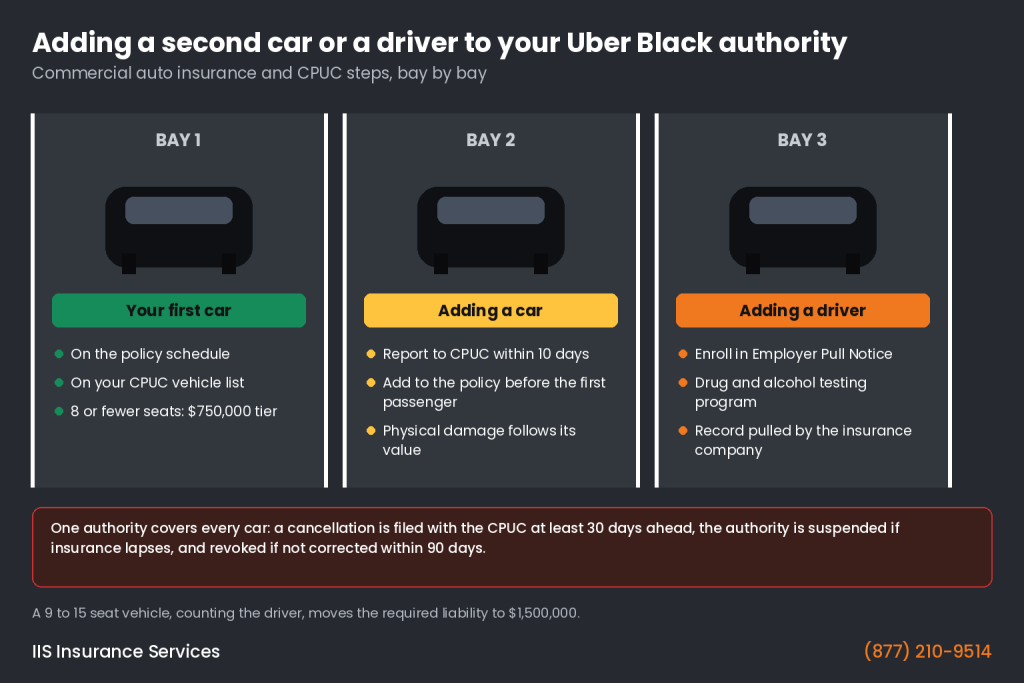
When you apply for charter-party authority, you give the CPUC a list of every vehicle you will operate. After that, the CPUC requires you to report within 10 days of adding or deleting any vehicle from your fleet. The same rule applies when you replace a car: the old one comes off the list, and the new one goes on.
Add the vehicle to the policy schedule
On the insurance side, every vehicle you operate has to be on the policy. The liability part is set by the CPUC tier. The physical damage part follows each vehicle’s value, so a second late-model luxury car adds its own physical damage premium, and a lender on that car will require physical damage coverage. Call us with the year, model, VIN, value, and lender before the car goes on the Uber app, not after. Each car also has to meet Uber’s own requirements. As of October 13, 2026, Uber’s Los Angeles page calls for a model year seven years old or newer, black exterior, black leather or vegan leather interior, and commercial insurance; Uber changes its lists often, so check Uber’s page for your city.
Watch the seat count on the new vehicle
The CPUC says the seating capacity of your largest vehicle determines the level of liability insurance you must keep. Adding another sedan or a seven-seat SUV keeps you at $750,000. Adding a van with 9 to 15 seats, counting the driver, moves your required liability level to the $1,500,000 tier, because the CPUC sets it by your largest vehicle. Call us before you buy a larger vehicle, not after.
Best for owner-operators growing to two or three vehicles: adding a driver
IIS Insurance Services walks owner-operators through the driver side of growth separately, because the CPUC’s rules for drivers are different from its rules for vehicles. Under the CPUC’s rules, the people driving under your authority have to be your employees, under your control, or independent owner-drivers who hold their own charter-party authority and operate as sub-carriers.
- Employer Pull Notice. The CPUC requires every carrier to enroll in the DMV’s Employer Pull Notice program, even an owner-operator with no employee drivers. When you add a driver, you enroll that driver under your account, and the DMV sends you a driver record when a reportable action happens, such as a conviction, an accident, or a suspension.
- Drug and alcohol testing. The CPUC requires a testing program for controlled substances and alcohol that covers your drivers, with educational materials for them.
- Workers’ compensation. Carriers with employees must have workers’ compensation insurance on file with the CPUC. The CPUC also notes rules for corporations, LLCs, and partnerships covering employees and officers, so ask before you hire.
- The insurance company. Every driver listed on the commercial vehicle has a motor vehicle record pulled. A driver with points or a recent accident can raise the premium a lot, and some insurance companies will decline a driver. Tell us about the driver before the first shift.
An independent owner-driver working as your sub-carrier is a different setup. That driver holds their own charter-party authority, and since every charter-party carrier must have liability insurance on file with the CPUC, they carry their own. Our post on Uber Black driver requirements and driving records covers what the insurance company looks for on a driver’s record.
| Change | CPUC side | Insurance side |
|---|---|---|
| Add a vehicle | Report it within 10 days of adding it | Add it to the policy before it carries a passenger |
| Replace a vehicle | Report the deletion and the addition within 10 days | Swap it on the policy; the lender may require physical damage coverage |
| Add a larger vehicle | Largest vehicle’s seating capacity sets the liability tier | 9 to 15 seats, counting the driver, means the $1,500,000 tier |
| Hire an employee driver | Employer Pull Notice, drug and alcohol testing, workers’ compensation on file | List the driver; the insurance company pulls the record |
| Use an owner-driver as a sub-carrier | The driver holds their own charter-party authority | The driver carries their own insurance on file with the CPUC |
Keeping Uber Black fleet insurance in force: one cancellation affects every car
IIS Insurance Services reminds growing operators that a fleet runs on one authority, so one missed payment puts every car at risk. California Public Utilities Code section 5391 requires liability protection to stay in effect for the life of the permit. If the policy is being canceled, the insurer’s representative files the cancellation with the CPUC no less than 30 days before the cancellation date, and failure to keep insurance in force results in suspension of the authority, with revocation if it is not corrected within 90 days of the suspension date.
Sometimes we see an owner-operator add a second car to the Uber app before it is on the policy schedule or the CPUC list, because the car was ready and the weekend was busy. That is the order to avoid. Report the car, put it on the policy, then drive it. If you are still building your first authority, our post on how to get a TCP permit in California covers the application, the fees, and the vehicle list.
Frequently asked questions
What insurance do I need for an Uber fleet in California?
IIS Insurance Services writes commercial auto coverage for each vehicle operated under your CPUC charter-party authority, at the General Order 115-G limit set by your largest vehicle’s seating capacity. The insurance company files proof with the CPUC, and every listed driver’s record is pulled.
Can I use my own commercial auto insurance for Uber Black?
IIS Insurance Services places owner-operators on their own commercial auto policies; for Uber Black in California, that is the requirement. The policy has to meet the CPUC minimums and be filed with the CPUC under your authority.
How much does commercial insurance cost for Uber Black?
IIS Insurance Services sees about $1,000 to $1,500 a month in 2026 for one car with a clean record, and violations push that a lot higher. A second vehicle adds its own premium, including physical damage based on its value.
How much is $1,000,000 liability insurance a month for Uber Black?
IIS Insurance Services quotes Uber Black sedans and SUVs at the CPUC’s $750,000 tier, since both seat 8 or fewer counting the driver. The monthly price depends on the vehicle, the drivers, and their records, so we quote it with those details in hand.
Do I have to report a new car to the CPUC?
IIS Insurance Services reminds every client that the CPUC requires a report within 10 days of adding or deleting any vehicle. The insurance company also needs the car on the policy before it carries a passenger.
Call IIS Insurance Services before you add a car or a driver
IIS Insurance Services was established in 2009 and has many years of experience writing commercial auto coverage. We shop several insurance companies that write livery, quote and bind by phone, and help clients in seven languages: English, Spanish, Korean, Russian, Ukrainian, Armenian, and Georgian. Have the new vehicle’s details or the new driver’s license ready and call (877) 210-9514.
Reviewed by George Karapetyan, IIS Insurance Services. CA license #0E94849, agency license #0G56765. Last reviewed October 2026.