

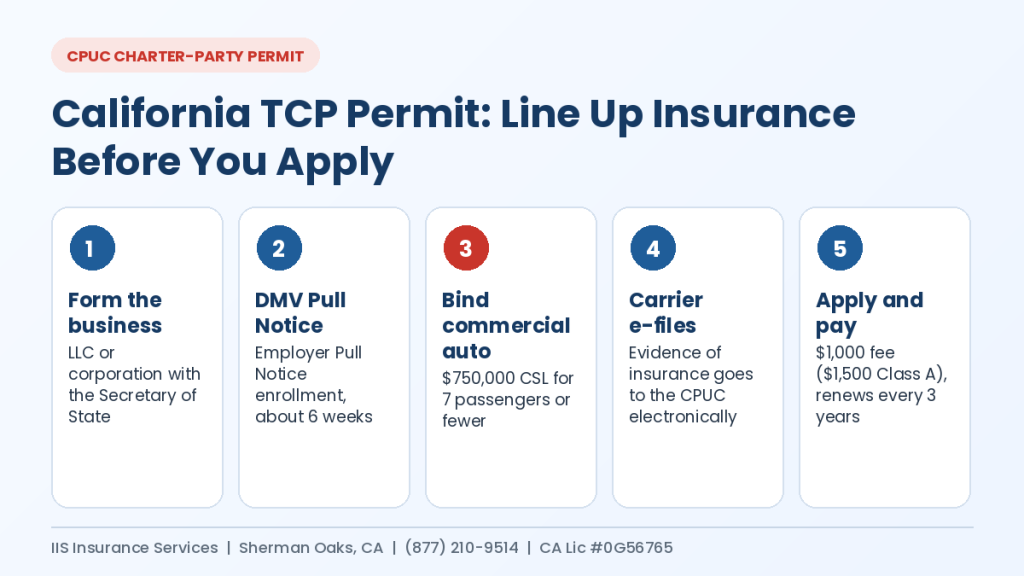
Before you apply for a California TCP permit, get your commercial auto insurance lined up. The California Public Utilities Commission will not issue or activate a charter-party permit until your insurance company has e-filed evidence of coverage, and the order you do things in decides whether you are paying for a policy weeks before you can use it.
This is the sequence IIS Insurance Services uses when we write commercial auto insurance for Uber Black and limo operators in Sherman Oaks and across California.
California TCP permit insurance, permit and application basics
A TCP (Transportation Charter-Party carrier) permit is the CPUC’s operating authority for prearranged, for-hire passenger transportation. Uber Black, Lyft Black, limos, wine tours, corporate shuttles and airport cars all run on it. The insurance requirement is written into the permit: under CPUC General Order 115, the carrier must keep public liability and property damage coverage on file at all times, at limits set by the vehicle’s seating capacity.
| Seating capacity | Minimum liability (combined single limit) |
|---|---|
| 7 passengers or fewer (8 people including the driver) | $750,000 |
| 8 to 15 passengers | $1,500,000 |
| 16 or more passengers | $5,000,000 |
Almost every Uber Black sedan and Black SUV falls in the first row. Stretch limos and sprinters usually land in the second.
What the CPUC application actually requires
Here is the current list from the CPUC’s charter-party licensing page, in the order we recommend doing it:
- Form the business and get a CA number if you need one. If you will operate as an LLC or corporation, file with the Secretary of State first so the TCP, the insurance and Uber’s records all carry the same name. Vehicles that seat more than 10, and any modified limo, need a CHP Motor Carrier Profile (CHP 362) and a CA number before the CPUC application.
- Enroll in the DMV Employer Pull Notice program. Allow about six weeks. The CPUC wants the enrollment confirmation with the application.
- Enroll in a drug and alcohol testing program. Required even for a single owner-operator.
- Bind your commercial auto policy. Give the carrier the VINs, seating capacities, drivers and your pending TCP application. Once bound, the carrier or surplus lines broker e-files evidence of insurance with the CPUC. You cannot file this yourself, and a paper certificate does not count.
- Workers compensation. Required if you have employees. If you are the only driver and an officer of your own corporation or LLC, you sign the CPUC officer waiver instead.
- Submit the application and fee. $1,000 for a standard permit, $1,500 for a Class A certificate, non-refundable. The permit renews every three years.
- CHP inspection, if it applies. Vehicles seating more than 10 (including the driver) and modified limousines get a CHP safety inspection before the CPUC activates them.
There is no bond requirement for a standard TCP permit. If a website tells you to buy a bond, it is confusing the TCP with a different license.
Coverage and vehicle details your agent will review
Before we quote, we look at the vehicle (year, value, seating capacity), how it is titled and registered, where it is garaged, every driver who will be behind the wheel, annual mileage, and whether you work Uber Black, Lyft Black, private clients or all three. Each detail changes eligibility and price. A vehicle that qualifies on the Uber app can still need separate underwriting approval from the livery carrier.
Insurance considerations for black-car, limo bus and app work
Black-car and limo policies need to state the use plainly: passenger transportation for hire, the vehicles, the service area and every driver. If you accept trips through Uber Black or Lyft Black, the platform will want a certificate showing at least $750,000 per vehicle and the TCP number. Hotels and corporate accounts may ask for additional insured and waiver of subrogation wording, and some airports ask for $1 million. Tell us who you will work with before we quote so the limit is right the first time.
We also review uninsured and underinsured motorist coverage, medical payments, physical damage and hired and non-owned auto. A new luxury SUV and a five-year-old sedan need different physical damage deductibles, and a financed vehicle needs the lender listed as loss payee.
Prepare for a TCP insurance quote and certificate request
Quotes go faster when the details are ready:
- Legal business name, contact information and TCP number, or a copy of the pending application.
- For each vehicle: year, make, model, VIN, seating capacity, ownership and current registration.
- For each driver: license number, date of birth, driving history and commercial driving start date, plus whether they are employees or contractors.
- How you work: Uber Black, Lyft Black, prearranged limo, airport transfers, corporate clients or a mix.
- Expected annual mileage, service area and any prior commercial losses. Send the current declarations page and loss runs if you have coverage now.
- For certificates: who needs it, the exact wording they asked for and the deadline.
With that in hand we can shop your quote, and your certificate is ready once the policy is bound. Call (877) 210-9514. If you plan to work airports, read our post on LAX airport permits for Uber Black and limo drivers before you apply, because LAWA has its own timeline.
California TCP permit insurance questions drivers ask
Is a personal auto policy or a rideshare endorsement enough for a TCP? No. The CPUC needs a commercial policy that the carrier can e-file. Personal policies cannot be filed and exclude for-hire use.
Does the vehicle have to be titled in the business name? Not always. A sole proprietor can insure a vehicle in their own name as long as the TCP application, the registration and the policy tell the same story about who owns it and how it is used. If you formed an LLC or corporation, the policy should be in that entity’s name.
What if I leave out app-based trips or airport work? Misstating the use is the fastest way to get a claim denied. Disclose everything, including subcontracted work for other limo companies.
How long does the whole process take? Plan on two to three months from forming the business to an active TCP, mostly because of the DMV Pull Notice wait. The insurance step itself takes a day or two.
If you are still deciding between a personal policy and a commercial one, our post on whether Uber Black needs commercial insurance in California settles it before you spend the application fee.
Frequently asked questions
What insurance is required for a California TCP permit?
Commercial auto liability at the CPUC minimum for your seating capacity ($750,000 for 7 passengers or fewer), e-filed with the CPUC by your carrier, plus workers compensation or an officer waiver.
Who files the insurance with the CPUC?
Your insurance company or surplus lines broker, electronically. The driver cannot file it.
How much does a TCP permit cost?
$1,000 for a standard permit or $1,500 for a Class A certificate, plus $15 per bus if applicable. Renewal is every three years.
Do I need a bond for a TCP permit?
No. A standard charter-party permit has no bond requirement.
Can I get a certificate of insurance for the CPUC, an airport, a hotel or a client?
Yes. The CPUC gets an electronic filing from the carrier, and you get a certificate of insurance to upload to Uber, Lyft or the airport.
What delays a TCP application?
Missing Pull Notice enrollment, an insurance filing that has not posted, business names that do not match across documents, and skipping the CHP step for vehicles that need it.
Does a TCP cover airport pickups?
No. Airports such as LAX, SFO and SAN run separate ground transportation permit programs on top of the TCP.