

A lot of the Uber Black drivers we insure do not stay Uber app-only for too long. A regular passenger asks for a direct number, a hotel concierge starts sending airport runs, a small company wants a car for its visiting executives. At that point you are running a black car service, and the question we get is whether the insurance changes. The short answer is that the same TCP authority and the same commercial policy cover the private work, as long as the trips are prearranged and the insurance company knows how the car is used. The CPUC decides the rules, the insurance company files the proof with the CPUC, and you pay the premium. This post covers the private-client side of the business. For the permit and the policy itself, see our page on Uber Black and limo insurance in California.
Black car insurance in California: the basics before you call
Black car service insurance is commercial auto insurance for a charter-party carrier, the CPUC’s term for a business that carries passengers for hire on a prearranged basis. Here is what IIS Insurance Services tells every owner-operator before we quote:
- You need CPUC charter-party authority, a TCP permit for most owner-operators, and the insurance company files proof of coverage electronically with the CPUC. Personal policies and rideshare endorsements do not qualify.
- General Order 115-G sets the liability minimum by seating capacity including the driver: $750,000 for 8 or fewer seats, $1,500,000 for 9 through 15, and $5,000,000 for 16 or more. Sedans and SUVs with 7 seats are in the $750,000 tier.
- 2026 quotes for one car with a clean record run about $1,000 to $1,500 a month. Violations push that a lot higher, and each added vehicle adds its own premium, with physical damage based on its value.
- Airports require their own permit on top of the TCP.
- IIS Insurance Services handles the insurance only. We do not file with the CPUC and we do not handle claims.
- We quote and bind by phone in seven languages. Call (877) 210-9514.
What a black car service is, and why the policy is called livery insurance
IIS Insurance Services uses the CPUC’s definition rather than the marketing one. A black car service is a charter-party carrier: a business that provides transportation only on a prearranged basis, in a vehicle it controls, for compensation. “Livery” is the insurance industry’s word for the same thing, for-hire passenger transportation, which is why the policy that covers a limo, a black car, and an Uber Black sedan is often called livery insurance, whatever name is on the quote. What matters is what the policy does: it meets the CPUC’s liability minimum, it is filed with the CPUC, and it covers the car while it is working.
Three CPUC rules from General Order 157-E shape how a black car service runs, and the insurance company expects you to be following them:
- Every trip is prearranged, and the driver carries a waybill for it: who booked the trip, the vehicle’s license plate number, and the points of origin and destination. Street hails are not charter-party work.
- The TCP number assigned by the CPUC is shown in full on the vehicle, on each side, or on the front and rear bumpers for smaller vehicles, readable during daylight at 50 feet.
- Records of the services performed, including waybills, are kept for at least three years.
Insurance coverage for private clients and corporate accounts: the certificate of insurance
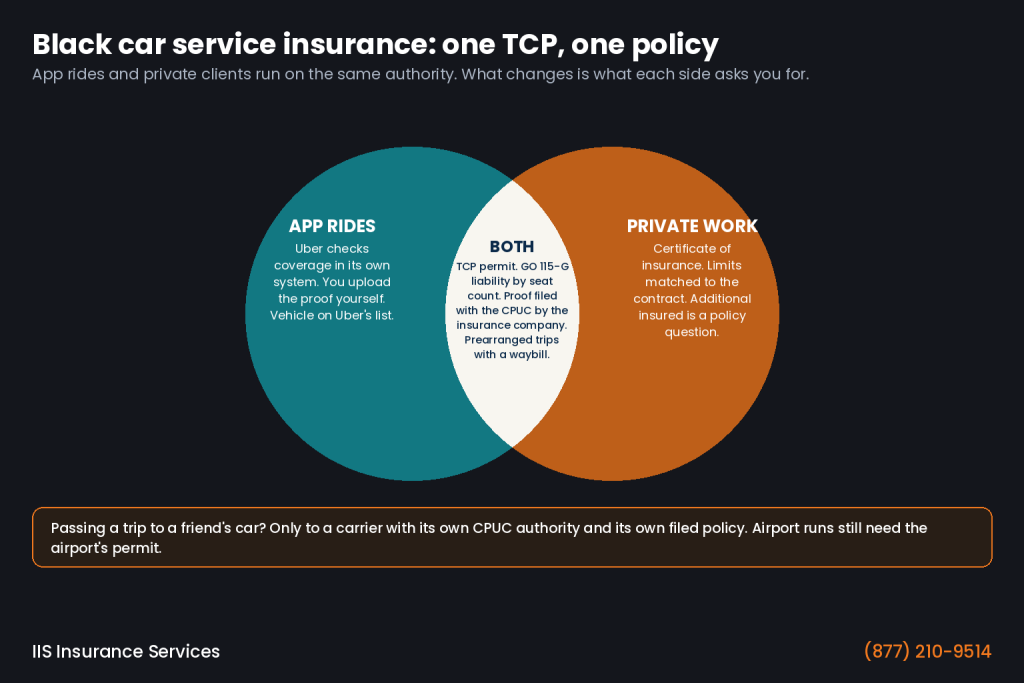
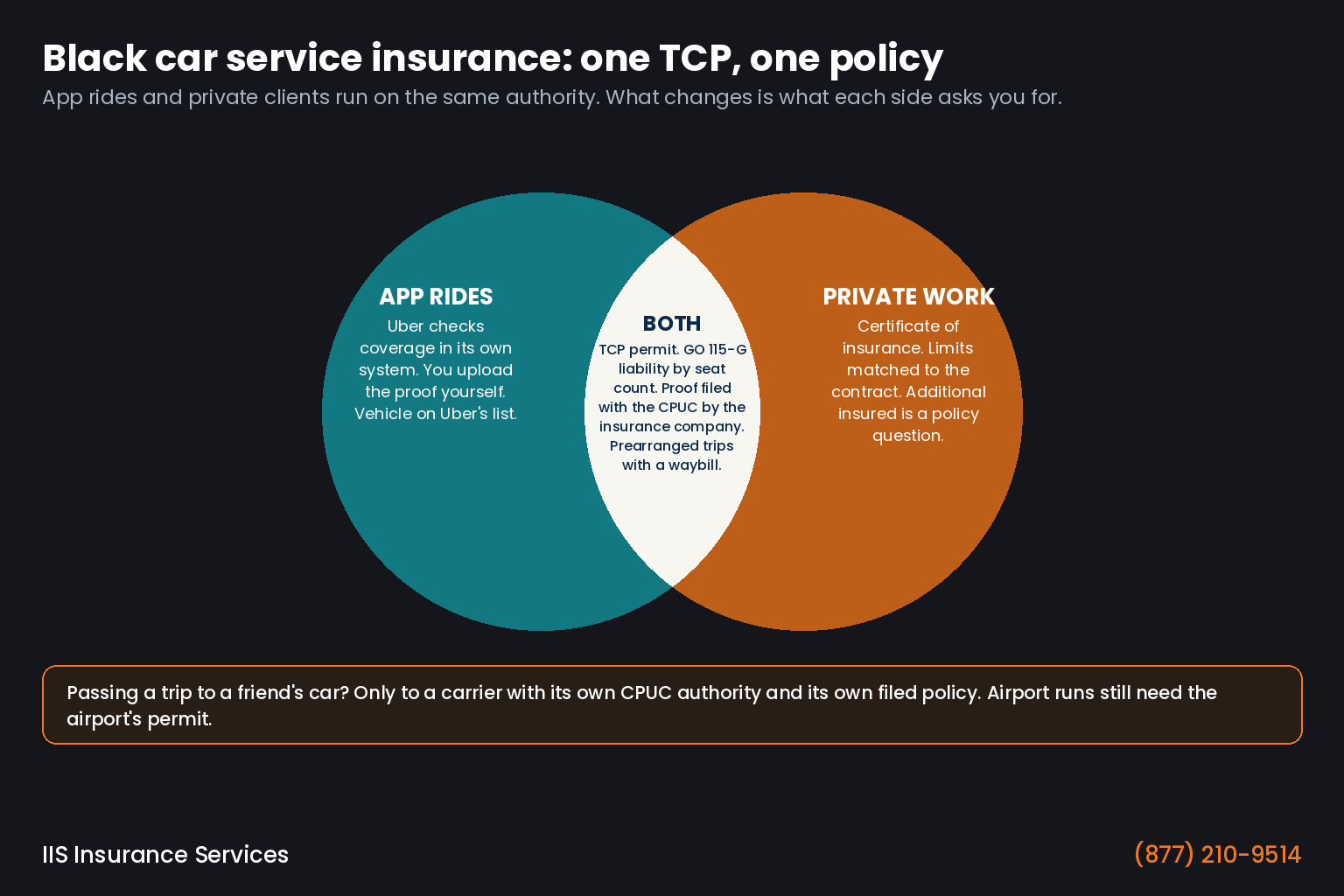
IIS Insurance Services sees the first real difference between app work and private work the day a corporate client asks for a certificate of insurance. Uber checks your coverage inside its own system, and you upload the proof yourself. A hotel, an event planner, or a company booking cars for its executives wants a certificate that shows the policy, the limits, and the dates, and sometimes asks to be listed as an additional insured. Whether the insurance company will add a client as an additional insured is a policy question, so ask us before you sign the contract rather than after.
Match the limits to what the contract asks for
A corporate contract may ask for a liability limit above the CPUC minimum for your seat count. The $750,000 tier satisfies the CPUC for a 7-seat SUV; it may not satisfy a client that wants $1,000,000 or more written into the agreement. Send us the insurance paragraph of the contract and we will tell you what the policy shows and what would have to change.
Do not hand off trips to a friend’s car unless that friend has a TCP permit too
When a corporate account sends more work than one car can handle, the tempting move is to pass a trip to a friend with a nice black SUV. General Order 157-E says a carrier may not use the services of another carrier that provides the vehicle and the driver unless that second carrier holds its own CPUC authority. The friend needs a TCP of their own, with their own filed policy, or the trip has to stay with you.
Airport runs still need the airport’s permit
Private airport work is a common request from corporate clients, and it does not change the airport rule. LAX and other airports require their own permit for commercial pickups, separate from the TCP, and the insurance company needs to know airport runs are part of the operation.
Best for owner-operators mixing app rides and private work: one TCP, one transportation insurance policy
IIS Insurance Services writes black car service policies for drivers who do both: Uber Black during the week, private and corporate trips on top. You do not need two policies or two permits. What you need is an accurate picture of the operation on the application, because the insurance company rates the car on how it is used, and a policy written for app-only work with no mention of airport runs or corporate contracts can become a problem later. Tell us about every kind of trip the car does.
| Your situation | CPUC side | Insurance side |
|---|---|---|
| App rides only | TCP permit, vehicle listed, proof filed by the insurance company | Commercial policy at the GO 115-G minimum for your seat count |
| Adding private clients | Same TCP; every trip prearranged with a waybill | Same policy; tell us how the car is used |
| Signing a corporate account | Same TCP; records kept three years | Certificate of insurance; limits matched to the contract; additional insured is a policy question |
| Airport pickups | Airport permit on top of the TCP | Airport work disclosed on the application |
| Passing trips to another car | Only to a carrier with its own CPUC authority | That carrier’s own filed policy covers that car |
Starting a limo or black car business from scratch: the order that works
IIS Insurance Services gets calls from drivers who want to skip the app and go straight to private clients, and the order of the steps is the same either way. Get the business set up, then apply for the TCP, then buy the policy so the insurance company can file the proof the CPUC needs to finish the permit. The CPUC’s application fee is $1,000 for a permit and $1,500 for a Class A certificate, and the CPUC says not to apply unless you can operate within two to three months. Our post on how to get a TCP permit in California covers the CPUC side step by step, and our post on limo insurance in California covers what changes when the business grows past a single sedan.
Frequently asked questions
What is considered a black car service?
The CPUC’s definition is the one that matters: a charter-party carrier that provides prearranged, for-hire passenger transportation in a vehicle it controls. A black car service is that business run with luxury sedans and SUVs, whether the trips come from an app, a hotel, or a corporate account.
What does livery mean in insurance?
Livery is an old word for a car that carries paying passengers, the same way a taxi or a limo does. In insurance, a livery policy is the commercial auto insurance policy written for that kind of use. A personal policy is written for a car that is not for hire, which is why it does not qualify for a TCP filing.
What does livery insurance cover?
A livery policy carries the liability limit the CPUC requires for your seat count, plus physical damage coverage on the vehicle if you want it or a lender requires it. The exact coverage parts are set by the policy, so read it with us before you sign.
How much is livery insurance?
IIS Insurance Services sees 2026 quotes of about $1,000 to $1,500 a month for one car with a clean record. Violations push that a lot higher, and each added vehicle adds its own premium, with physical damage based on the vehicle’s value.
What do I need to start a black car service in California?
IIS Insurance Services tells new operators the list is short but strict: a vehicle that meets the standard your clients expect, CPUC charter-party authority, a commercial policy at the General Order 115-G minimum that the insurance company files with the CPUC, and the airport permit if you plan on airport work.
Call IIS Insurance Services about black car insurance
IIS Insurance Services was established in 2009 and has many years of experience writing commercial auto coverage. Tell us how the car is used, app rides, private clients, corporate accounts, airport runs, and we will quote the insurance companies that write black car work in California and show you what the certificate will say before you sign a contract. We help clients in seven languages: English, Spanish, Korean, Russian, Ukrainian, Armenian, and Georgian. Call (877) 210-9514.
Reviewed by George Karapetyan, IIS Insurance Services. CA license #0E94849, agency license #0G56765. Last reviewed October 2026.