

People searching for the best SR-22 insurance in California usually mean the cheapest one that gets filed today. That matters, and we do it every day. But after binding SR-22 policies for years, we would define “best” differently: it is the policy that stays in force for the whole three years without a single lapse. The reason is that the three years do not always start when people think they do, a missed payment can set you back, and the DMV does not send a card in the mail saying you are finished. This post covers the calendar: when it starts, what restarts it, and how you know it is over. For how the filing itself works and what it costs, see our page on cheap SR-22 insurance in California.
When does the SR-22 insurance requirement start?
An SR-22 is a certificate the insurance carrier files electronically with the Department of Motor Vehicles. It is not a policy. The DMV or the court decides that you need one, and the requirement usually attaches to a suspension: a DUI, an uninsured accident, or another action on your driving record. The insurance requirements behind it are the same state minimums as any other liability insurance policy; the certificate just proves to the DMV that the coverage is in force.
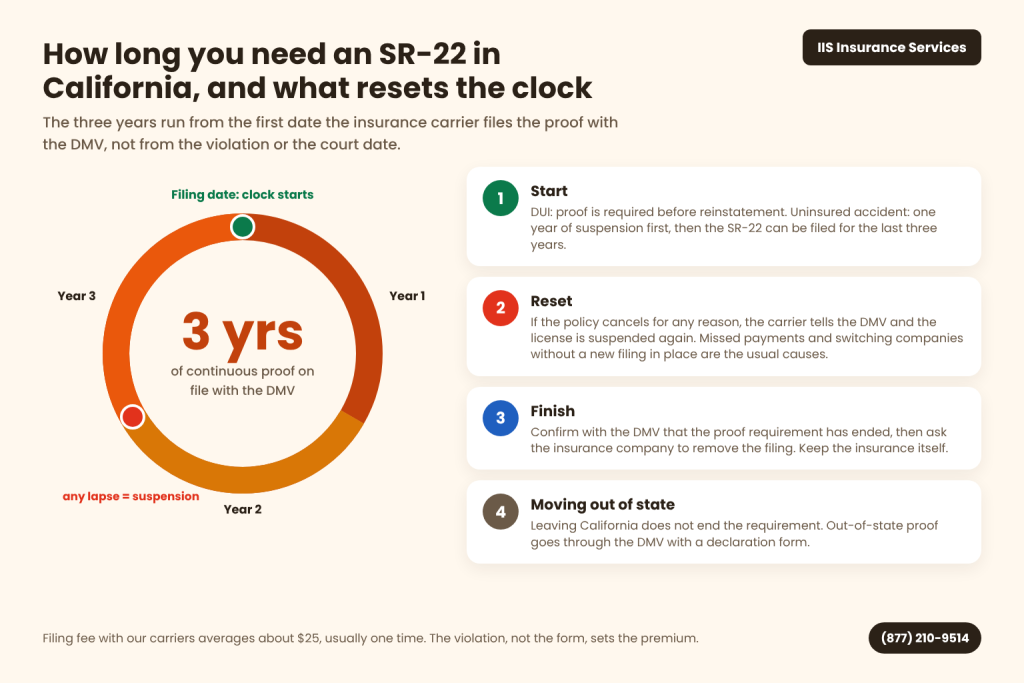
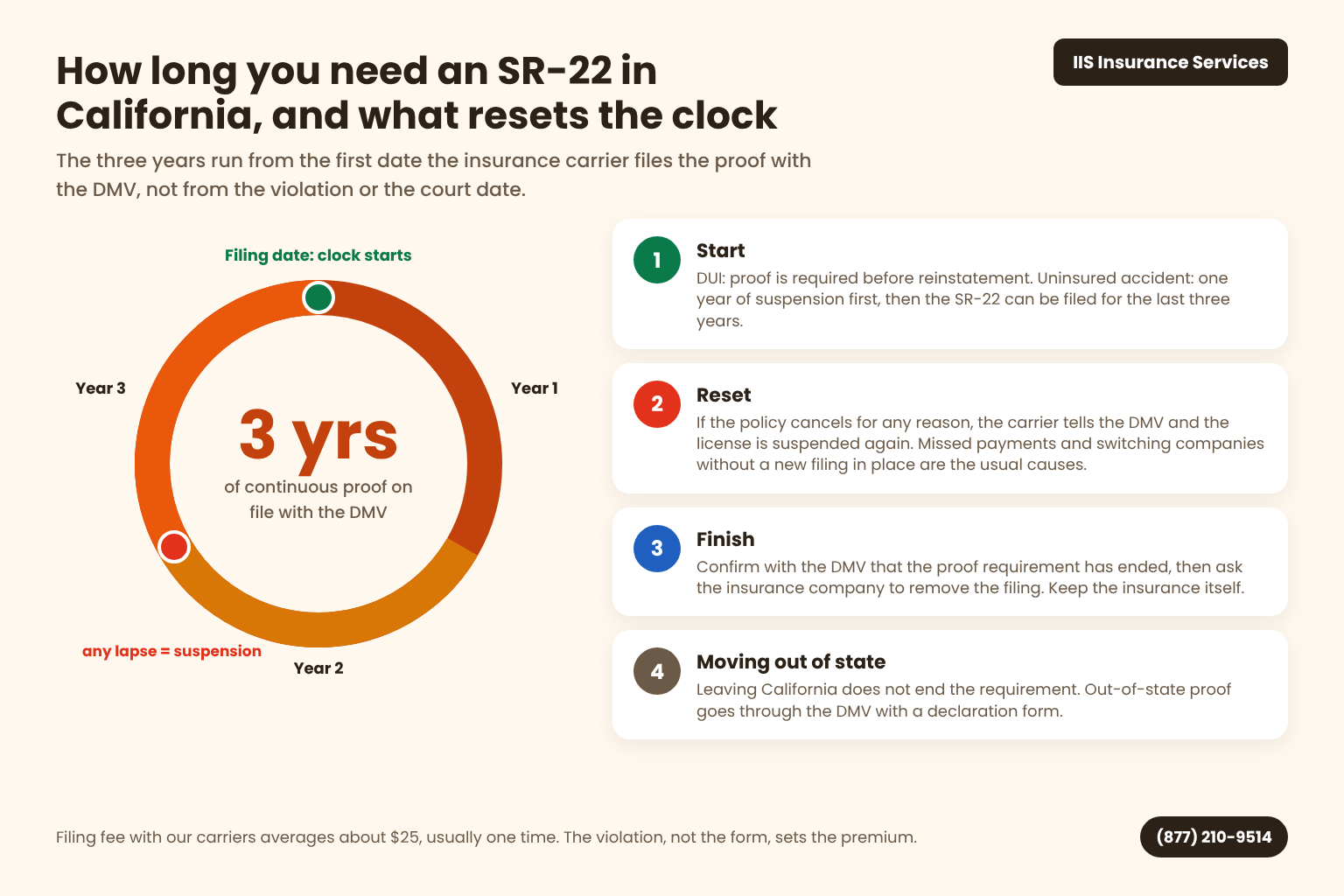
The DMV’s own paperwork for proof of financial responsibility says you will generally need to keep the proof on file for three years from the first date you file insurance to end the action. That is the key phrase: from the first date you file. The clock does not start on the day of the violation, and it does not start on the day of the court hearing. It starts when the insurance carrier’s SR-22 reaches the DMV and the DMV uses it to lift or shorten your suspension.
The uninsured accident case: a one-year wait before the insurance filing
If your license was suspended for an accident without insurance, the suspension can last up to four years, but the DMV lets you reinstate during the last three years by filing an SR-22. Under Vehicle Code 16072, that suspension cannot end until one year has passed from the date it actually began. So the timeline is one year of suspension, then three years of SR-22, and the SR-22 clock starts when you file, not before. Our post on SR-22 after an accident without insurance in California walks through that case.
The DUI case and your driving record
After a DUI suspension, Vehicle Code 13352 says your license is not reinstated until you give proof of financial responsibility. The three-year proof period then runs from that date. A DUI also marks you as a high risk driver with every insurance company, so the rates you are quoted reflect the conviction, not the certificate. Our post on SR-22 after a DUI in California covers the rest of that process.
| Situation | When the SR-22 can be filed | How long it stays on file |
|---|---|---|
| DUI suspension | When you are eligible for reinstatement or a restricted license | Three years from the first filing date |
| Uninsured accident suspension | After one year of the suspension has passed | Three years from the first filing date |
| Other DMV or court order | When the DMV or court tells you | Three years is typical; confirm with the DMV |
What makes SR-22 insurance the best: it never lapses, month after month
This is the part that costs people time. The DMV’s proof-of-financial-responsibility guidance is blunt: if proof is canceled for any reason during the three-year period, your driving privilege is suspended, effective on notice. The insurance company notifies the DMV when the policy cancels, and the DMV acts on it.
Reasons we see policies cancel mid-term:
- A missed payment. This is the most common one by far.
- Switching insurance companies without lining up the new SR-22 first. The DMV’s own instruction is to make sure the new proof is on file before canceling the old policy.
- Selling the car and canceling the policy without replacing it with a non-owner SR-22.
- Moving and letting the policy lapse.
Once the suspension is back, you need a new SR-22 to clear it. Whether the DMV counts your earlier months toward the three years is a question for the DMV, and the honest answer is to ask them for your specific record rather than assume. What we can tell you is that every lapse adds a reinstatement step, and some people end up carrying an SR-22 well past the three years they were originally told.
So when you compare SR-22 insurance quotes, look past the first month’s price. Most people compare quotes on the monthly rate alone. Ask how the payments work, whether automatic payment is available, and what happens if you are late. A policy that is $10 cheaper and cancels on day 31 is not the best one. The cheapest insurance on paper can turn into the most expensive if it lapses.
When can I remove my SR-22 in California?
Do not cancel the filing on your own at the three-year mark. Here is the order that works:
- Confirm with the DMV that the proof requirement has ended. You can request your driver record, or contact the DMV’s financial responsibility or Mandatory Actions Unit, depending on which action required the SR-22. Have your license number ready.
- Only after the DMV confirms, ask the insurance company to remove the SR-22 filing from the policy. The policy itself can continue; you just no longer need the certificate attached.
- Keep your insurance. Driving uninsured in California can lead to the same suspension that put the SR-22 on your record in the first place.
Sometimes we see a driver cancel the whole policy on what they believe is the last day, and the DMV’s date is a few weeks later. The result is a fresh suspension for a lapse that was avoidable with one phone call.
Moving out of state with an SR-22 insurance filing
Leaving the state does not end a California SR-22 requirement. The DMV has a form for drivers who now live in another state and still need to file proof to clear the action. A policy from an insurer in your new state can work if the insurer is authorized there and the policy meets California’s minimums of $30,000 per person, $60,000 per accident for injury, and $15,000 for property damage, and the DMV asks for a declaration from you with that certificate. Former California drivers who have established residency elsewhere can also apply to the DMV to terminate the action. Both routes go through the DMV, not the insurance agent, so contact the DMV before you move if you can.
Frequently asked questions
Which company offers the cheapest SR-22 insurance in California?
It changes with the driver. The violation on your record, your years of experience, and your annual miles move the auto insurance rates more than the insurance company’s name does, which is why we shop several companies and compare quotes for each SR-22 instead of sending everyone to one. The filing fee with our carriers averages about $25, usually one time.
How long do you need SR-22 insurance in California?
Three years in most cases, counted from the first date your insurance carrier files the proof with the DMV to end the action. A lapse can suspend your license again and add time.
When can I remove my SR-22 in California?
When the DMV confirms your proof requirement has ended. Check with the DMV first, then ask your insurance company to remove the filing. Removing it early triggers a suspension.
How do I know if I still need an SR-22?
Request your driver record from the DMV or contact the DMV unit that handled your action. The DMV does not send a notice saying you are finished, so the record is the reliable source.
How much more is SR-22 insurance than regular insurance?
The certificate itself adds very little: the filing fee with our carriers averages about $25, usually one time. What raises the premium is the violation behind it. A DUI or an uninsured accident moves you into high risk auto insurance rates, and under Proposition 103 the Good Driver Discount is lost with a DUI in the past 10 years or more than one point. Liability only at the state minimum keeps the number as low as it can go.
Does a DUI go away after 10 years in California?
Under Proposition 103, the Good Driver Discount is lost with a DUI in the past 10 years, so 10 years is the window that matters for your rate. The SR-22 requirement itself is separate and is generally three years from the first filing.
Need SR-22 insurance filed today?
IIS Insurance Services has handled SR-22 filings in California since 2009. We usually get the filing to the DMV the same day, we shop several insurance companies, and we tell you the broker fee in writing before you buy. We help clients in seven languages: English, Spanish, Korean, Russian, Ukrainian, Armenian, and Georgian. Call (877) 210-9514.
Reviewed by George Karapetyan, IIS Insurance Services. CA license #0E94849, agency license #0G56765. Last reviewed October 2026.